




Key Takeaways
- Double cleansing works best when it’s thorough but low-friction: dissolve makeup/sunscreen first, then lightly cleanse sweat and residue—without chasing a “squeaky clean” feeling.
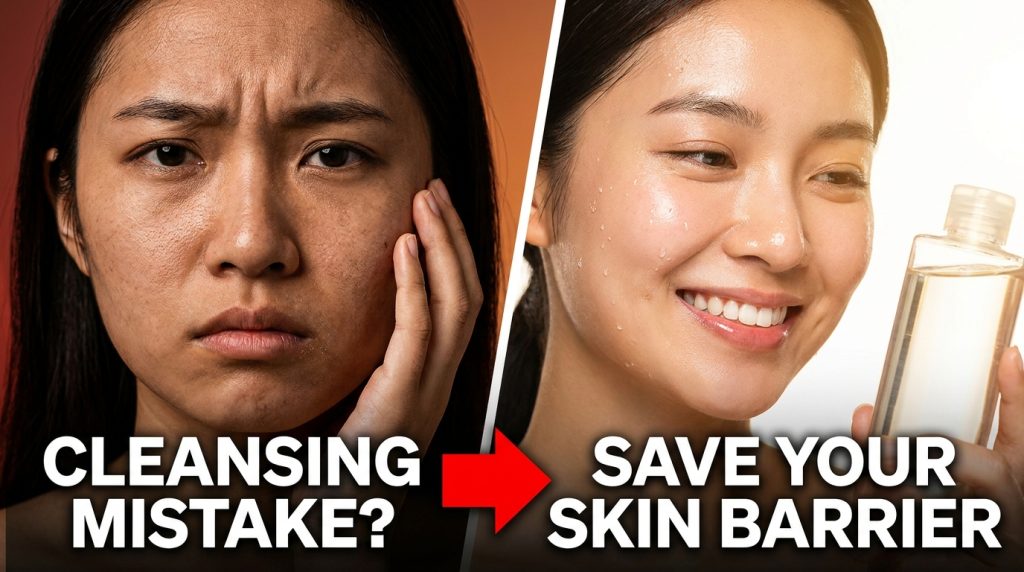
- If your skin gets tight, stingy, or flaky, the issue is often *how* you cleanse (hot water, harsh surfactants, rubbing) as much as *what* you use—your barrier is asking for gentleness.
- The most “barrier-friendly” routine is usually the simplest: first cleanse + mild second cleanse + moisturiser, adjusted for Singapore’s heat, sweat, air-con dryness, and mask-wearing.
Introduction
Let’s be honest: most of us don’t remove makeup in a spa-like setting with a fluffy headband and unlimited time. It’s usually after a long day—humid commute, sunscreen reapplications, maybe a workout, maybe a full face for work—followed by the classic “I just want to wash my face and lie down” moment.
That’s exactly why cleansing can go wrong.
When you’re tired, you scrub. You use hot water. You do “one more pass” with a cotton pad until it looks clean. Or you use a cleanser that leaves your skin feeling almost *too* clean… and then wonder why your face stings when you apply your next serum.
This guide is about how to remove makeup gently—specifically, how to do a gentle double cleansing routine that gets rid of sunscreen, makeup, and pore-clogging residue *without* messing with your skin barrier protection. We’ll keep it practical for Singapore life (heat, sweat, air-con, and mask friction), and we’ll also talk about choosing cleansers in a way that’s grounded, not hype-y.
Along the way, I’ll reference a couple of Nano Singapore formulas where they genuinely fit the conversation—like their first-cleanse remover and a mild water-based cleanser—so you can see how to read ingredients and evaluate “gentle” claims like a grown-up.
—
What “gentle double cleansing” actually means (and when you need it)
The goal: remove makeup/sunscreen *and* keep the barrier comfortable
A lot of people hear “double cleansing” and assume it’s automatically better skincare. But the real goal isn’t doing more steps—it’s getting to clean, comfortable skin with the least irritation possible.
Your skin barrier (mainly the stratum corneum, the outermost layer) is basically your body’s frontline: it helps keep water in and irritants out. When cleansing is too aggressive, that barrier can feel tight, stingy, dry, or reactive.
So a *gentle* double cleanse aims to:
- Dissolve oil-based stuff efficiently (sunscreen, longwear base, mascara) *without rubbing*
- Remove leftover sweat/dirt/residue with a mild water-based cleanse
- Leave your face feeling clean but not tight
If your skin feels “squeaky,” that’s not a gold standard. It’s often a sign you’ve stripped too much.
Double cleansing vs single cleansing: what changes (and what doesn’t)
What changes with double cleansing
- You use a first cleanser to dissolve stubborn layers (often an oil/balm, or sometimes micellar/cleansing milk).
- You follow with a second cleanser (water-based) to lift away what’s left.
What doesn’t change
- You still need a gentle touch.
- You still need to rinse properly.
- You still need to moisturise if your skin dries out in air-con (which is… most of us).
In other words: double cleansing doesn’t “fix” harsh cleansing. It can actually worsen irritation if you do two aggressive steps back-to-back.
Who benefits most in Singapore
Double cleansing tends to be most useful if you regularly have:
- Daily sunscreen + base makeup (tinted sunscreen, foundation, concealer)
- Longwear or waterproof eye makeup
- Frequent reapplication of sunscreen (outdoor work, lunch walks, sports)
- Commute + humidity + sebum that makes everything stick harder
- Gym days where sweat and sunscreen mix (and then you apply more)
Singapore’s heat and humidity can increase sweat and oil production, and that combo can make sunscreen and makeup cling more tenaciously. A gentle, non-stripping cleanse can remove it without provoking the “angry skin” spiral.
When a single gentle cleanse is enough (and when double cleansing can be overkill)
You might not need a full double cleanse every night if:
- You wore no makeup, and only a light, non-waterproof sunscreen
- You stayed mostly indoors and didn’t reapply multiple layers
- Your skin is currently irritated, over-exfoliated, or flaring (eczema, dermatitis)
On these days, one well-chosen, mild cleanse done properly can be enough.
A simple self-check:
- If you rinse and your skin still feels slippery/filmy, you may need a first cleanse (or better rinsing).
- If your skin feels tight or stingy, you may need to back off intensity (less friction, milder surfactants, shorter time, more moisturiser).
—
Why harsh cleansing backfires: the skin barrier, TEWL, and irritant dermatitis (simple science)
Here’s the thing: your skin barrier is surprisingly easy to annoy. And cleansing is one of the fastest ways to do it because it’s repetitive—twice a day, every day, for years.
Quick barrier primer: the stratum corneum is the main “shield”
The stratum corneum is the outermost layer of your epidermis. It’s often described as a brick-and-mortar structure:
- “Bricks” = dead skin cells (corneocytes)
- “Mortar” = lipids (fats) that keep the structure sealed and flexible
When this “seal” is healthy, your skin holds onto water better and is less reactive. When it’s disrupted, you’re more prone to dryness, stinging, redness, and irritant reactions.
What happens when the barrier is disrupted: higher TEWL and easier irritation
One way researchers talk about barrier disruption is transepidermal water loss (TEWL)—basically, how much water escapes through the skin.
When TEWL increases, you’re more likely to notice:
- Tightness right after cleansing
- Flaking around the nose/mouth
- Stinging with products that “never used to sting”
- Red patches that come and go
And once the barrier is compromised, irritants can get in more easily—so even mild friction or a little fragrance can feel like a personal attack.
Common “too harsh” culprits (Singapore edition)
Harshness isn’t only about one “bad” ingredient. It’s usually a pile-up of small stressors:
- Strong surfactants or high-foam cleansers
Foam isn’t evil, but “very foamy + daily + long contact time” can be too stripping for some skin types.
- Very hot water
Hot showers are comforting. Your barrier doesn’t care. Lukewarm is the compromise.
- Long cleansing time
If your cleanser sits on your skin while you brush teeth, scroll TikTok, and think about life… that’s extra exposure for no benefit.
- Over-washing
More cleansing isn’t automatically more “pore cleansing.” It can be more inflammation.
- Mask friction + air-con dryness
Singapore reality: masks + cold office air can leave your cheeks reactive and dry, even if your T-zone is oily.
Friction counts: rubbing and tugging can worsen irritation
People often focus on products and ignore technique. But repeated mechanical friction—especially on eyelids and around the nose—can add up.
If you’re using cotton pads, wipes, or you’re rubbing off mascara like you’re erasing permanent marker, you’re not just removing makeup—you’re also irritating the surface.
A good cleansing routine should feel almost… boring. Gentle glide, short time, no drama.
If you’re consistently getting redness, burning, swelling, or a rash from cleansing or makeup remover, it may be irritant or allergic contact dermatitis—and the best move is to stop the trigger and get medical advice if it doesn’t settle.
—
Step-by-step: how to remove makeup gently with a barrier-friendly double cleansing routine (5–7 minutes)
This is the routine I’d suggest if you want a reliable method that fits real life. Not a 12-step spa ritual—just a solid, barrier-respecting system.
Step 0: Prep (30 seconds)
- Wash your hands (seriously—this matters more than fancy skincare)
- Tie hair back
- If you wear contacts, consider removing them first if you’re doing heavy eye makeup removal
Step 1 (first cleanse): choose your makeup/sunscreen “dissolver”
Your first cleanse is about dissolving what clings: sunscreen films, sebum, foundation, waterproof mascara.
You can use an oil, balm, micellar water, or cleansing milk depending on your skin and your makeup.
One example of a rinse-off first cleanse is Nano Singapore’s Pore Detox Makeup Remover, which is positioned as a makeup/sunscreen remover with a “clean pores + skin comfort” angle. Ingredient-wise, it includes a blend of cleansing agents/solubilisers (like polyglyceryl-10 laurate and PEG-6 caprylic/capric glycerides), plus skin-comfort and hydration-supporting ingredients such as panthenol (vitamin B5) and sodium hyaluronate, and a fermented ingredient galactomyces ferment filtrate. (nanosingaporeshop.com)
That mix is useful to understand, because “gentle” removers often aim to do two jobs at once:
1) lift off stubborn films, and
2) reduce that post-cleanse tightness feeling.
A short note before the comparison table
A lot of irritation comes from choosing the wrong first-cleanse format for the day (then compensating with rubbing). So here’s a quick way to compare options.
| First cleanse option | Key benefits | Best for | Notes (barrier-friendly use) |
|---|---|---|---|
| Cleansing oil/balm | Dissolves longwear base + high-coverage sunscreen efficiently | Full makeup days, waterproof products | Massage with light pressure on dry skin; emulsify with a little water before rinsing to reduce residue |
| Rinse-off makeup remover (oil-in-water style) | Removes makeup/sunscreen while rinsing clean; can feel less heavy than oils | People who dislike heavy oils; daily sunscreen + base makeup | Look for a formula that rinses without leaving tightness; avoid over-using cotton pads |
| Micellar water | Quick removal without needing a sink immediately | Late nights, travel, minimal makeup days | Try to minimise friction—press/hold briefly, then wipe gently; rinse after if your skin is sensitive |
| Cleansing milk/cream | Often more comfortable for very dry or eczema-prone skin | Dry, reactive, “tight after washing” skin | Use short contact time and lukewarm water; don’t over-cleanse if your barrier is already irritated |
How to read this table: choose the first cleanse that removes what you’re wearing with the least rubbing. If you’re doing three rounds of wiping to “make micellar work,” you might actually be better off with an oil/balm or a rinse-off remover that melts product faster.
Step 1 technique: glide, emulsify, rinse (2 minutes)
- Apply to dry skin (unless the product says otherwise)
- Use fingertips, not nails
- Glide over cheeks, nose, forehead, chin
- For eye makeup: press gently for a few seconds, then wipe softly downward (don’t tug laterally)
If it’s an oil/balm: wet your hands and massage lightly until it turns milky (emulsifies), then rinse.
Step 2 (second cleanse): mild water-based cleanser (1 minute)
Second cleanse isn’t meant to “punish” the skin. It’s there to remove leftover sweat, particulate grime, and any remaining residue from the first cleanse.
A water-based cleanser can still be gentle—even if it foams a little—if the surfactants are mild and the formula rinses without tightness.
Nano Singapore’s Vitamin C Facial Cleanser is positioned for oily/combination skin and includes a surfactant blend (for example, potassium cocoyl glycinate and coco-glucoside) alongside panthenol and glycerin-related humectants for comfort. (nanosingaporeshop.com)
The “Vitamin C” in it is listed as 3-O-ethyl ascorbic acid, a vitamin C derivative. (nanosingaporeshop.com)
Whether you use this cleanser or another brand, the key is the feel:
- Clean after rinsing
- Not tight
- Not stingy
Rinse and dry without damage (1 minute)
- Rinse with lukewarm water
- Rinse longer than you think you need (residue can irritate, and leftover cleanser can feel drying)
- Pat dry with a soft towel—don’t rub
Dermatologists explicitly recommend lukewarm water, fingertips (not washcloths), and patting dry to reduce irritation. (aad.org)
Finish strong: moisturiser (1 minute)
Even if you’re oily, a light moisturiser can help after cleansing—especially if you spend your day in air-conditioned offices.
If you’re using acne actives (retinoids, benzoyl peroxide), moisturising after cleansing becomes less “optional” and more “how do I keep my face from freaking out.”
—
Choosing cleansers (and protecting your barrier) in real Singapore life
This last section is where we tie it all together: product selection, routine adjustments, mistakes to avoid, troubleshooting, and a quick safety checklist.
What “mild” looks like on a label (and on your face)
A label can’t tell you everything, but you can still make smarter guesses.
Signs a cleanser is *more likely* to be mild
- “Fragrance-free” (especially important if you’re sensitive)
- Lower-foam or “gentle foam”
- Surfactants often associated with gentler cleansing (for example, glucosides, betaines, glycinate-based surfactants)
Signs you might need to be careful
- Very strong “deep clean” positioning if you’re already dry/irritated
- Strong fragrance (even if it smells “natural”)
- Multiple exfoliating acids *plus* frequent double cleansing (too much, too fast)
And then there’s the simplest test: after rinsing, your skin should feel comfortable. If it feels tight, something’s off—either cleanser choice, water temperature, time, or friction.
Fragrance-free matters for sensitive skin (and why)
If you’re prone to sensitivity, fragrance is a common reason products trigger dermatitis. It’s not that fragrance is “toxic”—it’s that it’s a frequent irritant/allergen for a subset of people. If you’ve ever had a product that caused a mysterious rash, switching to fragrance-free and minimal-ingredient formulas is often a practical reset.
Acne-prone vs dry/sensitive: picking textures and actives without overdoing it
If you’re acne-prone or clog-prone
- Prioritise thorough removal of sunscreen and base makeup (residue + sebum can contribute to follicle blockage)
- Keep your second cleanser mild—don’t stack harsh cleansing with harsh acne actives
- Consider using actives (like benzoyl peroxide or adapalene) in leave-on form rather than trying to make your cleanser do everything
If you’re dry, dehydrated, or eczema-prone
- Reduce cleansing intensity: shorter time, fewer steps on low-makeup days
- Choose creamy textures or gentle rinsing removers
- Moisturise promptly after cleansing (especially if you work in air-con)
Also: eczema-prone skin often benefits from avoiding harsh soaps and using moisturising strategies that trap water in the skin. (nhs.uk)
How often should you cleanse? The “not too little, not too much” approach
Cleansing frequency is one of those topics where the best answer is… “it depends, but don’t go extreme.”
- If you wear sunscreen and/or makeup daily, evening cleansing is non-negotiable.
- If you’re acne-prone, many people do well with twice daily cleansing. A clinical trial in acne found that washing 2 times daily improved lesions more than washing once daily or four times daily—suggesting that “more” isn’t automatically better. (See references.)
- If you’re very dry or reactive, a water rinse or very mild cleanse in the morning may be enough, then do a proper cleanse at night.
The American Academy of Dermatology’s public guidance also commonly emphasises gentle technique and avoiding irritating tools. (aad.org)
Common mistakes that damage the barrier (and what to do instead)
Mistake 1: Hot water + long cleansing time
Fix: lukewarm water, keep total cleansing time reasonable (your face doesn’t need a 10-minute soak in surfactants).
Mistake 2: Over-exfoliating + double cleansing on the same night
Fix: if you’re exfoliating (AHA/BHA/scrubs), keep cleansing extra gentle that night. Don’t stack “deep clean” behaviours.
Mistake 3: Too many cotton pads/wipes (friction overload)
Fix: if you use micellar, press and hold first, then wipe once gently; rinse after if you’re sensitive.
Mistake 4: Trying to “squeaky clean” clogged pores
Fix: clogged pores respond better to consistency (proper removal, gentle cleansing, appropriate acne actives) than to harshness.
Mistake 5: Not rinsing well (residue) vs over-washing (stripping)
Fix: rinse thoroughly, but don’t keep cleansing repeatedly. If you’re not getting clean with two steps, it’s usually a product mismatch or technique issue.
Troubleshooting: clogged pores, stinging, and breakouts after double cleansing
If you’re breaking out
- Consider three possibilities:
1) residue isn’t fully removed (common with heavy sunscreen),
2) you’re irritated (irritation can mimic “breakouts”), or
3) a specific product doesn’t suit you.
- Try changing *one variable at a time* (first cleanser format, second cleanser gentleness, or technique).
If products sting or burn
- That’s a red flag for barrier disruption or irritant contact dermatitis. Stop the trigger, simplify, and moisturise.
- If you develop swelling, blistering, hives, or a persistent rash, get medical advice.
Mayo Clinic notes that contact dermatitis can involve burning/tenderness and is commonly triggered when irritants damage the skin’s protective outer layer (including repeated exposure to soap and water). (mayoclinic.org)
If you feel dry and tight
- Reduce water temperature
- Cut cleansing time
- Consider switching to a gentler second cleanser or a creamier format
- Add moisturiser immediately after cleansing (don’t wait until your skin feels “fully dry”)
If makeup still remains
- Technique upgrade: massage a little longer on the first cleanse, emulsify properly, and rinse thoroughly
- If it’s only around the eyes, use the “press and hold” method rather than rubbing
Safety checklist: patch testing, eye-area care, and when to see a doctor
- Patch test new products if you’re sensitive: try a small area (jawline/behind ear) for several days.
- Stop rules: burning, swelling, hives, worsening rash—stop the product and seek help if it persists.
- Eye safety: avoid getting removers into the eyes; rinse thoroughly if it happens. If you have pain or vision changes, get urgent care.
- When to seek medical advice: persistent rash, widespread irritation, eczema flare that doesn’t settle, or any severe reaction.
—
A quick note on supporting your skin barrier from the inside (without getting weird about it)
Cleansing is topical, but your skin also reflects basics like sleep, stress, nutrition, and underlying conditions.
If you’re someone who likes the “inside-out” approach, you might also explore evidence-informed supplementation for general skin support—things like protein adequacy, omega-3 intake, and specific nutrients if you’re deficient. Nano Singapore has a full “skin health” range (for example, collagen-focused formulas and antioxidant blends), and if you prefer to buy supplements online, your best bet is to evaluate products the same way you’d evaluate skincare:
- Look for clear serving sizes and ingredient amounts (not just “proprietary blend” mystery).
- Avoid stacking multiple products with overlapping ingredients (more isn’t always safer).
- Prefer brands that disclose quality standards (e.g., GMP manufacturing, third-party testing), and don’t be shy about asking for documentation if you’re taking supplements long-term.
Think of supplements as supportive—not a substitute for sunscreen, not a substitute for moisturiser, and definitely not a substitute for gentle cleansing.
—
Conclusion
If you take nothing else from this, take this: gentle cleansing is less about the trend and more about the *outcome*. Your skin should be clean, calm, and comfortable—especially in Singapore, where heat, sweat, daily sunscreen, air-con dryness, and mask friction can all push your barrier in different directions.
A barrier-friendly double cleansing routine is usually:
1) a first cleanse that dissolves makeup/sunscreen with minimal rubbing,
2) a mild second cleanse that finishes the job, and
3) moisturiser to keep your skin from tipping into tightness and irritation.
If you’re adjusting your routine and want a straightforward place to start, you can always browse and compare options—and do it slowly, one change at a time—via this link: buy supplements online
Frequently Asked Questions
FAQ 1
Do I need to double cleanse every single night?
No. If you wore heavy sunscreen, longwear makeup, or waterproof products, double cleansing helps. On low-makeup days, one gentle cleanse may be enough—especially if your skin is dry or reactive.
FAQ 2
Is micellar water “gentle” for sensitive skin?
It can be, but the main issue is often friction. If you need multiple rounds of wiping, irritation risk goes up. Try press-and-hold first, wipe gently, and consider rinsing after.
FAQ 3
Why does my skin feel tight after cleansing even when my cleanser says “hydrating”?
Common reasons: hot water, cleansing too long, using too much product, not moisturising after, or your barrier is already compromised from actives (retinoids/exfoliants). “Hydrating” on a label isn’t a regulated guarantee.
FAQ 4
Can double cleansing cause breakouts?
It can if you’re leaving residue (not emulsifying/rinsing well) *or* if you’re irritating your skin barrier and triggering inflammation that looks like acne. Simplify, reduce friction, and change one variable at a time.
FAQ 5
What’s the safest way to remove waterproof mascara without tugging?
Use the press-and-hold method: soak a small amount of remover on clean fingertips or a soft pad, press gently over closed lashes for several seconds, then wipe downward softly. Avoid side-to-side rubbing on the lash line.
References
- https://pmc.ncbi.nlm.nih.gov/articles/PMC2921764/
- https://pubmed.ncbi.nlm.nih.gov/19665786/
- https://www.aad.org/public/everyday-care/skin-care-basics/care/face-washing-101?pp=1
- https://www.mayoclinic.org/diseases-conditions/contact-dermatitis/symptoms-causes/syc-20352742?p=1
- https://www.nhs.uk/tests-and-treatments/emollients/
- https://health.clevelandclinic.org/how-to-wash-your-face
Disclaimer
All the content on this blog, including medical opinion and any other health-related information, is solely to provide information only. Any information/statements on this blog are not intended to diagnose, treat, cure or prevent any disease, and should NOT be a substitute for health and medical advice that can be provided by your own physician/medical doctor.
We at Nano Singapore Shop encourage you to consult a doctor before making any health or diet changes, especially any changes related to a specific diagnosis or condition.
