


Key Takeaways
- Retinoids are still the best-studied anti-ageing topicals, but irritation is common—especially when you’re new, sensitive, or inconsistent.
- Bakuchiol is a promising “retinol alternative” with early clinical data suggesting similar improvements in wrinkles and pigmentation with better tolerability for some people.
- In Singapore, the gentlest routine is the one you’ll actually stick to: daily sunscreen, barrier support, and a realistic ramp-up plan matter more than chasing the “strongest” active.
Introduction
If you’ve ever tried retinol and thought, “Why is my face suddenly… crispy?”—you’re not alone. A lot of people start retinoids for fine lines and texture, only to end up juggling peeling, stinging, and makeup that clings to every dry patch like it has a personal vendetta.
And in Singapore, the skin comfort struggle can feel extra dramatic. The outdoor heat and humidity can make you oily and reactive, while constant air-con can quietly dehydrate your skin barrier. Add year-round UV intensity, and it’s no surprise many of us are looking for anti-ageing options that work *without* turning our nightly skincare into a tolerance test.
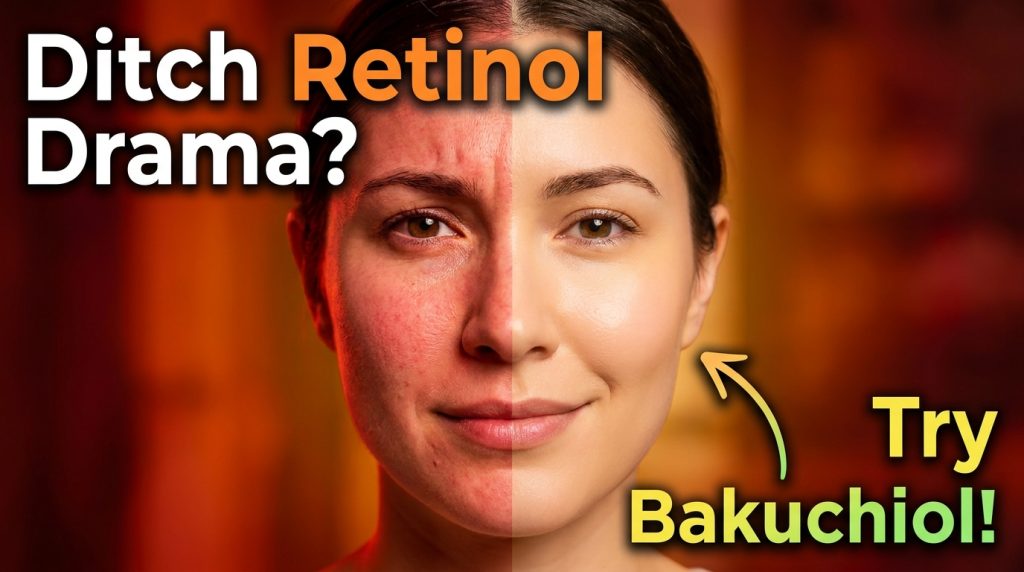
That’s where the “bakuchiol vs retinol” conversation comes in. Bakuchiol is plant-derived, often marketed as gentler, and has some clinical data behind it. Retinol is a classic, backed by decades of dermatology use—yet it can be irritating, especially at the start.
Let’s put the hype aside and talk about what each ingredient actually does, who each one is best for, and how bakuchiol fits into a genuinely gentle anti-ageing skincare routine you can maintain in real life.
Bakuchiol vs retinol: the quick verdict for Singapore skin
Who this guide is for (sensitive skin, beginners, busy routines)
This is for you if:
- You’ve tried retinol before and your skin threw a tantrum (peeling, burning, redness that lasts).
- You’re new to retinoids and want a safer entry point.
- You’re dealing with a compromised barrier (tightness, flaking, eczema-leaning skin, frequent irritation).
- You want anti-ageing benefits, but you also need your skin to look calm under sunscreen and makeup—especially in Singapore’s climate.
What each ingredient is best for (evidence strength vs tolerability)
Here’s the honest framing:
- Retinoids (including retinol) have the *strongest* track record for improving signs of photoageing—fine lines, uneven texture, and dyspigmentation—because they influence cell turnover and dermal collagen support. The downside is that irritation is common, particularly when you start or increase frequency.
- Bakuchiol has *emerging but meaningful* evidence. A well-known 12-week randomized, double-blind trial compared bakuchiol 0.5% (twice daily) with retinol 0.5% (once daily) and found improvements in wrinkles and hyperpigmentation in both groups—with less scaling and stinging reported in the bakuchiol group. That doesn’t make bakuchiol a perfect “swap” for prescription retinoids, but it does make it a reasonable option for people who prioritize comfort.
What “gentle anti-ageing” really means in hot, humid weather + air-con
A gentle routine isn’t “weak.” It’s low-drama and high-consistency.
In Singapore, gentle anti-ageing usually means:
- You can wear it comfortably under sunscreen every day.
- You’re not constantly cycling through irritation → recovery → irritation again.
- You protect your barrier (because an inflamed barrier makes everything feel stronger—retinol, acids, even “nice” moisturizers).
- You treat sunscreen like skincare, not an optional extra. UV is a major driver of visible ageing, and it can also amplify irritation when you’re starting actives.
Bakuchiol vs retinol: side-by-side comparison (what to choose)
Most people don’t need a “perfect” choice—they need the choice that matches their skin, schedule, and tolerance. Use this table as a practical shortcut.
| Option | Key benefits | Best for | Notes |
|---|---|---|---|
| Retinol (OTC) | Strong anti-ageing track record; supports texture, fine lines, tone over time | People who can start slow and tolerate some adjustment | Often used at night; irritation is common early on—think “train for it,” not “try it once.” |
| Prescription retinoid (e.g., tretinoin) | Most robust evidence for photoageing and acne | Experienced users under clinician guidance | Can be very effective but also more irritating; not a DIY upgrade. |
| Bakuchiol | Early clinical data for wrinkles + pigmentation; often better tolerated | Sensitive/reactive skin, retinoid-intolerant, beginners who want daily comfort | “Gentler” doesn’t mean “can’t irritate”—patch testing still matters. |
| Bakuchiol blends (bakuchiol + hydrators/barrier helpers) | Combines bakuchiol benefits with hydration and barrier support | People who want a simpler routine and less dryness | Check the full INCI list—some blends include retinoid derivatives, exfoliants, or fragrance that can change tolerability. |
Read the table like this: start with your constraint (sensitivity, time, willingness to troubleshoot) and then choose the strongest option you can use consistently. The “best” active on paper is pointless if you can’t tolerate it long enough to see results.
What retinoids (including retinol) do—and why they’re still the gold standard
What counts as a retinoid vs cosmetic retinol
“Retinoid” is a family term for vitamin A derivatives. In skincare, you’ll commonly hear about:
- Retinol (over-the-counter cosmetic retinoid)
- Retinal/retinaldehyde
- Prescription retinoids (like tretinoin/adapalene, depending on country/indication)
The key idea: many forms ultimately work by interacting with the skin’s retinoid pathways. But they’re not all equally strong—or equally irritating.
How retinoids improve photoageing (cell turnover + collagen support)
Photoageing isn’t just “wrinkles happen.” UV exposure changes how skin behaves: uneven shedding, rough texture, pigment irregularities, and collagen breakdown.
Topical retinoids are well-supported in dermatology literature for improving signs of photoageing. They help normalize how skin cells mature and shed (so texture looks smoother), and they’re associated with improvements in dermal collagen over time—one reason they’re often considered the anti-ageing “benchmark.”
Why irritation happens (and why it’s common)
Retinoid irritation isn’t a sign the product is “working better.” It’s usually a sign your barrier is overwhelmed by:
- Increased turnover before your skin adapts
- Reduced tolerance from overuse (too much, too often, too soon)
- Layering with other irritants (acids, strong vitamin C, benzoyl peroxide)
- Under-moisturizing (especially in air-con environments)
In Singapore, the sneaky pattern I see is: oily from humidity, so you skip moisturizer… then you add retinol… then air-con dries you out… and suddenly everything stings. Not because your skin is “weak,” but because you accidentally removed the buffer your barrier needed.
What results typically look like: timeline and expectations
Retinoids reward consistency, not intensity.
A realistic timeline (very general, depends on formulation and tolerance):
- Weeks 1–4: skin “adjustment” phase is common (dryness, mild peeling, slight redness)
- Weeks 6–12: texture may start to look smoother; early improvements in tone can appear
- 3–6 months: more noticeable changes in fine lines/overall clarity for many users
If you’re expecting glass skin in 10 days, retinol will feel disappointing. If you’re thinking in seasons instead of days, it makes much more sense.
What is bakuchiol—and what the evidence actually shows
Bakuchiol: plant-derived doesn’t automatically mean “non-irritating”
Bakuchiol is a compound associated with the plant *Psoralea corylifolia*. You’ll often see it pitched as “natural retinol,” but I’d be careful with that phrase.
“Plant-derived” tells you where something comes from—not how your skin will react to it. Botanicals can still trigger irritation or allergic contact dermatitis in some people. So yes, bakuchiol may be gentler *on average* for many users, but patch testing still matters, especially if you’re eczema-prone or reactive.
The head-to-head study snapshot (why people keep citing 0.5%)
The most cited clinical comparison is a randomized, double-blind 12-week trial in which:
- Bakuchiol 0.5% was used twice daily
- Retinol 0.5% was used once daily
Both groups saw significant improvement in wrinkles and hyperpigmentation over 12 weeks, and the retinol group reported significantly more facial scaling and stinging/burning during the study period.
A couple of practical “how to interpret this like an adult” notes:
- The study is 12 weeks, not 12 months. Encouraging, but not the final word.
- The regimens weren’t identical (twice-daily vs once-daily), which can affect tolerability comparisons.
- Formulation matters a lot: two products can both say “0.5% retinol” and feel totally different on skin.
Mechanism: how bakuchiol can be “retinol-like” without being a retinoid
Bakuchiol isn’t chemically a retinoid, but mechanistic work suggests it can influence a retinol-like gene expression profile in skin models. That overlap may help explain why it can support visible improvements in wrinkles, pigmentation, and texture in clinical studies.
Still, “retinol-like” doesn’t mean:
- identical results for everyone
- interchangeable with prescription tretinoin
- zero irritation risk
- safe in pregnancy by default (more on that soon)
Think of bakuchiol as a different tool that can hit some similar skin goals, often with a softer edge.
Who bakuchiol may suit in Singapore (and why comfort matters)
Bakuchiol can be especially appealing if:
- You’ve tried retinoids and couldn’t get past the irritation phase.
- Your skin is frequently barrier-compromised (tightness after cleansing, redness, flaking).
- You need a routine that behaves well under daily sunscreen (non-negotiable here) and doesn’t sabotage your makeup.
- You’re busy and want fewer “rules” (some people do better with a daily gentle product than a complicated schedule).
A real-world example: Nano Singapore’s Bakuchiol Plumping Serum – 30ml is positioned as a multi-ingredient formula that pairs bakuchiol with hydration and barrier-supporting ingredients like hyaluronic acid, niacinamide, panthenol, and allantoin (based on its published ingredient highlights). That kind of pairing is often what makes an anti-ageing active *feel* doable day-to-day—especially if you’re sensitive.
One important label-reading detail, though: this serum’s ingredient list also includes Hydroxypinacolone Retinoate (HPR), a retinoid-related ingredient, plus alpha-arbutin and vitamin E forms. That doesn’t make it “bad”—but it does mean if you’re extremely reactive, you’ll want to introduce it thoughtfully and avoid stacking it with other strong actives at the start.
How to start a gentle anti-ageing routine in Singapore (AM/PM templates + buyer guidance)
Non-negotiables first: cleanser, moisturiser, broad-spectrum sunscreen
Before we talk actives, let’s set the base. A gentle anti-ageing skincare routine in Singapore lives or dies by:
- A non-stripping cleanser (especially if you’re wearing sunscreen daily)
- A moisturizer you’ll actually use (light gel textures count if that’s what you’ll tolerate)
- Broad-spectrum sunscreen every morning—because UV exposure drives photoageing, and it’s also a common reason “my retinol isn’t working” (you’re undoing progress daily)
The World Health Organization explicitly highlights watching the UV index and using broad-spectrum sunscreen (UV-A and UV-B) and notes reapplication, especially with outdoor exposure. In Singapore’s year-round UV, this isn’t paranoia—it’s just sensible.
Option A (Beginner / sensitive): bakuchiol-focused routine for daily comfort
AM
1. Gentle cleanse (or just rinse if you’re dry/sensitive)
2. Moisturizer (optional, but helpful under air-con)
3. Sunscreen (and reapply if you’re outdoors)
PM
1. Cleanse
2. Bakuchiol serum
3. Moisturizer
If you’re using a multi-ingredient bakuchiol formula (like the Nano Singapore Bakuchiol Plumping Serum), keep the rest of your routine boring for the first 2–4 weeks. That’s not “wasting time”—that’s how you figure out whether the product suits you.
Option B (Beginner-to-intermediate): retinol “low and slow” routine (2–3 nights/week)
If you want retinol’s stronger evidence base but you’re prone to irritation, your goal is to ramp up slowly enough that you don’t quit.
PM (retinol nights, 2–3 nights/week to start)
1. Cleanse and fully dry your skin (damp skin can increase irritation for some)
2. Moisturizer (thin layer)
3. Retinol (pea-sized amount for entire face)
4. Moisturizer again (optional)
PM (recovery nights)
- Cleanse → moisturizer only (barrier repair is part of the plan)
The biggest mistake isn’t choosing the “wrong” retinoid. It’s starting at nightly use because you’re excited, then panic-stopping when your skin peels.
Option C (Advanced tolerance): alternating nights + recovery strategy
Once your skin is stable (think: no persistent sting, no constant flaking), you can do:
- Retinol nights (your established frequency)
- Recovery nights (hydration + barrier support)
- Optional gentle brightening on recovery nights (e.g., niacinamide)
In Singapore, alternating nights is often easier than trying to layer many actives at once. Humidity can make skin feel “fine” until it suddenly isn’t—so building in recovery nights is a smart buffer.
Where bakuchiol can fit if you also use retinol
Some people like bakuchiol on non-retinol nights as a “keep things moving gently” step. Whether that works depends on your skin and the formula.
If your bakuchiol product includes other actives (like a retinoid derivative, exfoliating acids, or strong brighteners), treat it with the same respect you’d give a retinol product. In other words: don’t assume it’s automatically a recovery-night product.
Irritation-proofing: what to do if you peel, sting, or flare
If your skin gets angry, you don’t need to “push through” blindly.
Try this:
- Drop frequency first (often enough to fix the issue)
- Simplify to cleanser + moisturizer + sunscreen for a few days
- Avoid applying to broken or eczema-flared skin
- Consider the sandwich method (moisturizer → active → moisturizer)
Be cautious with these when you’re starting retinoids or even bakuchiol:
- AHA/BHA exfoliants
- Benzoyl peroxide
- Strong vitamin C (especially low-pH ascorbic acid)
- Fragranced products if you’re reactive
Introduce one new active at a time. Your face is not a chemistry set.
Safety notes: pregnancy, breastfeeding, and when to see a clinician
This part matters, so I’ll be direct:
- Systemic retinoids are known teratogens. Because of that, topical retinoids are commonly avoided during pregnancy out of caution. If you’re pregnant, trying to conceive, or breastfeeding, it’s worth discussing your skincare with a clinician.
- Bakuchiol has limited pregnancy/lactation safety data. “Natural” isn’t the same thing as “proven safe.”
Consider medical advice if you have:
- swelling, hives, blistering, or a rash that spreads
- persistent dermatitis that doesn’t settle after stopping the product
- severe burning or pain
Buyer guidance (yes, including supplements): how to evaluate quality without getting played
Even though this article is mainly about topical skincare, a lot of people building an anti-ageing routine also look at “skin support” supplements—collagen peptides, vitamin C, antioxidants, and so on. If you’re going to go there, it’s worth being selective.
Here’s how I’d evaluate products—topicals *and* ingestibles—without turning it into a shopping frenzy:
1) Learn to read labels (topicals)
- Look for the active ingredient and concentration when it’s provided (e.g., “0.5% bakuchiol”).
- Scan for potential irritants if you’re sensitive: fragrance, essential oils, harsh alcohols.
- Notice “helper” ingredients that affect comfort: humectants (glycerin, hyaluronic acid), barrier-supporters (niacinamide, panthenol), soothing agents (allantoin).
2) For supplements, focus on dosing and form
- Collagen research often uses grams, not milligrams. If a “collagen” product hides the amount in a proprietary blend, it’s hard to judge.
- Vitamin C has clear reference intakes and upper limits from credible nutrition sources (NIH ODS is a good reference point).
- Don’t assume “more is better.” More is sometimes just… more.
3) Quality signals that matter
- Clear manufacturer standards (e.g., GMP practices)
- Transparent ingredient lists
- Realistic claims (supporting normal skin function is different from “erasing wrinkles”)
If you prefer to buy supplements online, a simple rule is: choose brands that make it easy to see what you’re taking, how much you’re taking, and why it’s included—without burying everything under marketing language.
If you want to browse by category rather than getting nudged by trends, Nano Singapore’s skin supplements for skin health collection is an example of a category page that makes it easier to compare formats. Whether you choose collagen, vitamin C, or something else, think of supplements as supportive—your sunscreen and topical routine will still do most of the visible heavy lifting.
Conclusion
If you’re stuck in the bakuchiol vs retinol debate, here’s the simplest way to decide: retinol is the evidence heavyweight, but it often asks for patience and careful ramping. Bakuchiol is a promising, typically gentler option, especially if your skin is sensitive, reactive, or you’ve bounced off retinoids before.
In Singapore’s heat, humidity, and air-con reality, the best anti-ageing routine is the one that keeps your barrier calm and your sunscreen consistent. Start with a comfortable baseline, introduce one active at a time, and give it at least a full 8–12 weeks before you judge results.
If you’re looking to explore options thoughtfully (without overcomplicating your routine), you can buy supplements online as a convenient way to compare products and labels at your own pace.
Frequently Asked Questions
FAQ 1
Can I use bakuchiol in the day under sunscreen?
Often, yes—many people use bakuchiol AM and/or PM. The key is still sunscreen every morning, because UV drives photoageing regardless of which active you choose.
FAQ 2
Will retinol make me “photosensitive” in Singapore’s sun?
Retinoids can make skin more irritation-prone during the adjustment phase, and sun exposure can worsen visible redness and pigmentation. Practically, that means daily broad-spectrum sunscreen and sensible sun habits matter even more when you’re starting.
FAQ 3
How long before I see results with bakuchiol or retinol?
A common reference point is around 12 weeks for visible changes in fine lines/texture and pigmentation in studies and real-world routines. Some people notice smoother texture earlier, but deeper changes take longer.
FAQ 4
Can I use these if I have acne or post-acne marks?
Retinoids are commonly used for acne and can help with post-acne marks over time, but they can be irritating. Bakuchiol may be a gentler option for some acne-prone users, though results vary—introduce slowly and don’t stack multiple harsh actives at the start.
FAQ 5
What if I’m already using exfoliating acids (AHA/BHA)?
If you’re starting retinol or a new bakuchiol product, it’s usually smarter to pause acids temporarily or reduce them to once weekly until your skin settles. Too many actives at once is a classic trigger for stinging and barrier flares.
References
- https://pubmed.ncbi.nlm.nih.gov/29947134/
- https://pubmed.ncbi.nlm.nih.gov/19192936/
- https://clinicaltrials.gov/study/NCT03112863
- https://www.ncbi.nlm.nih.gov/books/NBK582989/
- https://ods.od.nih.gov/factsheets/VitaminA-Consumer/
- https://ods.od.nih.gov/factsheets/VitaminC-Consumer/
- https://www.who.int/news-room/questions-and-answers/item/radiation-protecting-against-skin-cancer
Disclaimer
All the content on this blog, including medical opinion and any other health-related information, is solely to provide information only. Any information/statements on this blog are not intended to diagnose, treat, cure or prevent any disease, and should NOT be a substitute for health and medical advice that can be provided by your own physician/medical doctor.
We at Nano Singapore Shop encourage you to consult a doctor before making any health or diet changes, especially any changes related to a specific diagnosis or condition.
