

Key Takeaways
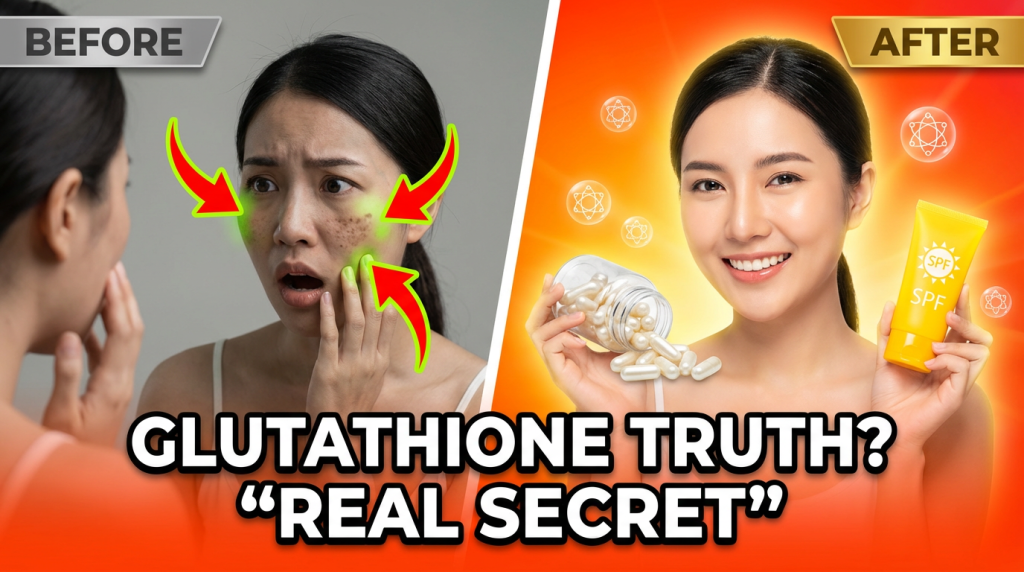
- “Skin brightness” is best understood as *even-looking tone, less dullness, and fewer noticeable dark marks*—not a promise to “whiten” or change your natural skin colour.
- Oral glutathione has *some* human evidence suggesting modest, gradual changes in certain pigmentation-related measurements, but the overall evidence base is still limited and effects aren’t guaranteed. (pmc.ncbi.nlm.nih.gov)
- If you try glutathione, think “antioxidant support + realistic expectations,” avoid risky/unregulated injections, and keep sunscreen as your non-negotiable foundation. (aad.org)
Introduction
If you’ve lived in Singapore for more than five minutes, you know the drill: you’re careful with skincare, you’re mostly consistent… and then a few sunny weekends, a bit of post-acne inflammation, or just plain stress shows up on your face as “dullness” or uneven-looking tone.
That’s usually when glutathione enters the chat.
Glutathione is everywhere in Asian beauty conversations—often framed as a “brightening” or “whitening” shortcut. But here’s the thing: the most useful way to approach this topic (especially if you care about safety) is to separate what glutathione *actually is* in human biology from what marketing implies it can do for skin. Glutathione is a real, important antioxidant made in the body, with roles in protecting cells from oxidative stress and supporting normal physiological function. (cancer.gov)
So in this guide, we’ll look at *human evidence* for oral/topical/injectable glutathione and what it may (or may not) mean for skin appearance—while staying grounded, realistic, and very pro-sunscreen.
—
What people mean by “skin brightness” in Singapore (and why wording matters)
Brightness vs “whitening”: even-looking tone, dullness, and visible pigmentation
In everyday Singapore talk, “bright” skin usually means some combination of:
- Less dullness (skin looks more “awake”)
- More even-looking tone (fewer noticeable patches)
- Less contrast between dark marks and surrounding skin (post-acne marks, sun spots, melasma-like patches)
It’s *not* the same as promising to “whiten” you into a different person. That’s not just unrealistic—it also tends to push people toward risky choices (like unregulated injections) and disappointment cycles.
A more realistic goal is: support your skin’s resilience so that pigmentation triggers (UV, inflammation, irritation) don’t leave as much “visible evidence” behind.
How Singapore’s year-round UV and humidity affect spots, tan, and post-acne marks
Singapore’s UV exposure is basically a constant background factor. Even when you’re not “sunbathing,” daily commuting, lunchtime walks, or sitting near windows can add up. UV triggers melanin production because melanin is protective—your skin is literally trying to shield itself.
Humidity adds another twist: people often cleanse more, exfoliate more, or use stronger actives to feel “less oily.” Overdoing it can irritate the skin barrier, and irritation/inflammation can worsen the look of uneven tone over time.
So if “brightness” is your aim, your foundation is:
- Sun protection
- Barrier-friendly skincare
- Inflammation management (gentle routines, acne control, avoiding over-exfoliation)
Glutathione—if it helps at all—should sit *on top of* these basics, not replace them.
What glutathione claims usually imply—and what this article will and won’t claim
This article will:
- Explain glutathione’s role as an antioxidant in the body (cancer.gov)
- Summarise what human studies suggest about oral glutathione and measures like melanin index or UV spots (pmc.ncbi.nlm.nih.gov)
- Talk honestly about limitations, variability, and safety (including why injections add risk) (dpcj.org)
This article won’t:
- Promise “instant whitening”
- Claim glutathione treats medical conditions like melasma
- Encourage unregulated IV drips
—
Glutathione 101: what it is and what it does in the body (and why that matters for skin)
Let’s ground this in biology for a moment—because it’s easy to forget that glutathione wasn’t “invented” for beauty trends.
Glutathione’s role in antioxidant defense and redox balance (core biology)
Glutathione is a naturally occurring molecule in the body, often described as a key intracellular antioxidant. One major way to think about it: it helps your cells handle oxidative stress—the wear-and-tear chemistry that happens when reactive molecules outpace your antioxidant defenses. (cancer.gov)
Oxidative stress is relevant to skin appearance because UV exposure and inflammation can increase oxidative stress signals in skin—one reason antioxidants are so often discussed in skincare and nutrition.
But (and this is important) “antioxidant support” isn’t the same as “skin tone transformation.” It’s more like giving your body better tools to maintain balance under stress.
Detoxification pathways and immune support: health roles vs cosmetic expectations
You’ll often hear glutathione linked to “detox.” In the body, glutathione participates in detoxification pathways and helps protect cells by supporting normal redox balance. (cancer.gov)
That doesn’t automatically translate to visible changes in skin pigmentation. It *could* support overall resilience (including skin), but cosmetic outcomes are a separate question—and need human data.
How the body makes and uses glutathione (and why ‘more’ isn’t always better)
Your body synthesises glutathione from amino acids (including cysteine). That means glutathione status isn’t just about taking a pill—it’s also influenced by diet quality, protein intake, and overall health.
And more isn’t always better because:
- The body tightly regulates antioxidant systems
- Different people absorb and respond differently
- Over-fixating on one antioxidant can crowd out the bigger picture (sleep, sun habits, diet pattern)
This is also why many nutrition researchers emphasise dietary patterns rich in naturally occurring antioxidants rather than relying solely on single-ingredient supplementation. (nutritionsource.hsph.harvard.edu)
—
What human evidence says about glutathione for skin appearance (and how oral, topical, and injectable compare)
The phrase glutathione benefits for skin gets thrown around like the science is massive. It’s not. The human evidence is real—but relatively small, and the outcomes are typically modest and variable. (dpcj.org)
What we actually have (and what the trials measured)
Two commonly cited placebo-controlled human studies include:
- A 4-week randomized, double-blind, placebo-controlled study looking at oral glutathione (500 mg/day) and changes in skin melanin index, with secondary outcomes including UV spots measured by imaging tools. (pubmed.ncbi.nlm.nih.gov)
- A 12-week randomized, double-blind, placebo-controlled, parallel study assessing oral glutathione (including reduced and oxidized forms) and outcomes including melanin index and UV spots, again with site-to-site variation. (pmc.ncbi.nlm.nih.gov)
A systematic review in *Dermatology Practical & Conceptual* discusses glutathione for skin lightening and highlights that overall evidence is limited and stronger studies are still needed—especially before anyone makes confident promises. (dpcj.org)
Trial timelines: why changes (if any) are gradual
Even when results are statistically significant, the timeframes are typically weeks, not days. That matters because a lot of consumer expectations are shaped by “before/after in 7 days” marketing—which is not how biology usually works.
If you decide to trial an oral supplement, your expectation should be closer to:
- “subtle shift over 1–3 months”
- “maybe nothing noticeable”
- “results depend heavily on UV exposure habits”
Oral vs topical vs injectable glutathione: a practical comparison
Before you choose a route, it helps to compare evidence + practicality + risk in one place.
| Option | What the evidence *most strongly supports* | Best for | Notes / red flags |
|---|---|---|---|
| Food-first antioxidant pattern (fruits/veg/whole grains, variety of colours) | Broad health support; antioxidants work as networks in foods | People who want foundational, low-risk support | Not a “spot corrector,” but supports overall resilience; a good baseline even if you supplement (nutritionsource.hsph.harvard.edu) |
| Oral glutathione (capsules/tablets) | Limited human RCT signals for modest changes in some pigmentation-related measures over 4–12 weeks | People who already do sunscreen + gentle skincare and want to trial a supplement with realistic expectations | Effects aren’t guaranteed; results can vary by body site and person; avoid “instant whitening” claims (pubmed.ncbi.nlm.nih.gov) |
| Topical glutathione | Less consistent evidence; depends heavily on formulation/penetration | People who prefer topical routines and can tolerate slow experimentation | “Topical antioxidant” doesn’t always mean it reaches target pathways; patch test if sensitive (dpcj.org) |
| Injectable/IV glutathione for cosmetic “whitening” | Not supported by strong cosmetic evidence; added procedural risk | Generally not recommended for cosmetic goals | Higher risk (infection/contamination/adverse reactions), plus regulatory/ethical concerns; avoid unregulated services (dpcj.org) |
| Example oral formulation you’ll see in Singapore: reduced glutathione + vitamin C + “white tomato” carotenoids | Vitamin C supports antioxidant functions and collagen formation; some products pair it with glutathione for “antioxidant support” | People who prefer combined formulas and transparent labels | Check exact dosages and full ingredient list; don’t assume “complex” means clinically proven (nanosingaporeshop.com) |
How to read this table: start from the left with evidence strength and risk. The more invasive the route, the more you should demand robust medical justification—and cosmetic “brightness” usually isn’t enough justification to accept injection-level risk.
A quick note on supplement forms, “bioavailability,” and marketing traps
You’ll see terms like “reduced glutathione (GSH)” and “oxidized glutathione (GSSG)”—and sometimes big promises about absorption. In the 12-week trial on PMC, both reduced and oxidized forms were studied, which is interesting, but it doesn’t magically erase the broader reality: human outcomes are variable and evidence is still limited. (pmc.ncbi.nlm.nih.gov)
If you want a grounded way to choose:
- Prefer products that clearly state which form (e.g., reduced GSH) and exact dose
- Avoid proprietary blends that hide amounts
- Be wary of claims that sound like “guaranteed shade change”
If you’re browsing Singapore options and you want an example of a label that explicitly lists a combined antioxidant approach, Nano Singapore’s Glutathione Complex – 120ct lists L-glutathione plus vitamin C and white tomato extract on its product page. Use it as a *label-reading exercise*: look for clarity on ingredients, stated purpose, and whether claims stay in the “support” lane rather than the “promise” lane. (nanosingaporeshop.com)
And if you’re the type who likes to browse by category (instead of chasing whatever’s trending on social media), Nano Singapore’s skin-focused collection is also organised here: skin health supplements. (nanosingaporeshop.com)
(One practical tip while you buy supplements online: don’t just compare price per bottle—compare price per effective daily dose, and check how many weeks a bottle actually lasts at the dose you plan to use.)
—
Safety, red flags, and an evidence-aligned “brightness support” plan (sunscreen-first)
Let’s talk about the part that often gets skipped in “brightening” conversations: risk management.
Avoid unregulated injections (especially for cosmetic goals)
From a public health perspective, injections carry risks that supplements simply don’t:
- infection risk from needles/poor sterility
- contamination risk from questionable sources
- dosing/quality uncertainty
- adverse reactions that are harder to reverse quickly
Even the more cautious medical discussions and reviews point out that glutathione’s cosmetic “whitening” use is not backed by strong evidence, and injection routes add avoidable danger—especially outside appropriate medical care. (dpcj.org)
If a service is advertised like a casual beauty add-on (“just pop by for a drip”), treat that as a red flag.
If you’re pregnant, breastfeeding, or managing chronic conditions: check first
Cosmetic supplementation is optional—so the bar for safety should be high.
- Pregnant/breastfeeding: talk to your clinician first.
- Chronic conditions or multiple meds/supplements: ask about interactions and suitability.
- History of asthma/allergies: be extra cautious; stop if you notice wheeze, hives, swelling, or unusual reactions.
Also, remember NCCIH’s general guidance: antioxidant supplements shouldn’t replace medical care or a healthy diet, and “more” isn’t automatically better. (nccih.nih.gov)
Supplement quality checklist (Singapore-friendly and practical)
If you decide to try oral glutathione, here’s what I’d look for—regardless of brand:
1. Transparent dosing
– How many mg of glutathione per serving?
– What form is used (e.g., reduced GSH)?
2. A full ingredient list
– No mystery blends.
– Watch for extras you may be sensitive to.
3. Manufacturing quality signals
– GMP manufacturing claims are a plus, but don’t treat them as a magic shield.
– If a brand provides testing info or consistent batch practices, that’s even better.
4. Claims that match the evidence
– “Supports antioxidant defense” is reasonable.
– “Instant whitening” is not.
On Nano Singapore’s product page for Glutathione Complex, for example, the brand describes a blend of L-glutathione with vitamin C and white tomato extract (phytoene/phytofluene) and positions it around antioxidant support—use that as a reference point for what “transparent ingredient storytelling” looks like, even if you ultimately choose another product. (nanosingaporeshop.com)
Dose and timeframe: what matters based on human studies
If you read the actual study designs (instead of just the marketing summaries), you’ll notice:
- the 4-week trial used 500 mg/day (pubmed.ncbi.nlm.nih.gov)
- the 12-week trial used 250 mg/day (and evaluated reduced vs oxidized forms) (pmc.ncbi.nlm.nih.gov)
That doesn’t mean those are the “best” doses for everyone. It does mean:
- effects (if present) were measured over weeks
- mega-dose approaches don’t automatically have better evidence
- consistency matters more than hype
The “brightness support” plan: what to do if you want to trial oral glutathione responsibly
If you want something simple and evidence-aligned, try this:
Step 1: Lock in sunscreen first (2 weeks before you start anything new).
The American Academy of Dermatology recommends broad-spectrum, water-resistant sunscreen with SPF 30 or higher on skin not covered by clothing. (aad.org)
If sunscreen isn’t consistent, any “brightening” effort is basically fighting upstream.
Step 2: Keep the skincare routine boring.
Cleanser, moisturiser, sunscreen. If you’re adding actives (like retinoids, acids), add only one at a time and don’t irritate your barrier—irritation can worsen uneven tone.
Step 3: Trial one supplement at a time for 8–12 weeks.
Why 8–12? Because that’s the scale used in the better-known oral glutathione trials and related work. (pmc.ncbi.nlm.nih.gov)
Step 4: Track like a skeptic.
- Take photos in the same lighting weekly.
- Note UV exposure (outdoor lunches? beach days?).
- Note new breakouts/irritation.
If nothing changes after 12 weeks, that’s useful data: glutathione may simply not be your lever.
Diet-first antioxidant habits (the unsexy part that works)
If you want antioxidant support that has broad scientific plausibility, zoom out:
- more colourful plants (fruits/veg)
- whole grains and legumes
- adequate protein (amino acids matter for many body systems)
- consistent sleep
Harvard’s nutrition guidance highlights that antioxidants in foods tend to work best as networks with other nutrients and plant compounds—one reason supplement trials often don’t show the same benefits as food patterns. (nutritionsource.hsph.harvard.edu)
NCCIH also cautions against using antioxidant supplements as a substitute for diet or medical care. (nccih.nih.gov)
One more quiet hero: vitamin C (and why it’s commonly paired)
Vitamin C is frequently paired with glutathione in supplement formulations for a reason: in the body, vitamin C acts as an antioxidant and is also needed for collagen formation. (ods.od.nih.gov)
This doesn’t mean “vitamin C = brighter skin guaranteed,” but it explains why combined antioxidant formulas are popular—and why reading the label (dosage, form, and purpose) matters.
When to see a dermatologist
If you suspect melasma, have rapidly changing pigmentation, or you’re dealing with persistent post-acne marks that really affect your confidence, a dermatologist can:
- confirm diagnosis (not everything “dark” is the same problem)
- recommend evidence-based topicals or procedures
- help you avoid wasting money on trends that don’t match your skin biology
—
Conclusion
If you came here hoping for a simple yes/no on glutathione: it’s more nuanced than that.
Glutathione is undeniably important in human biology as a core antioxidant, and that’s worth respecting—separate from beauty marketing. (cancer.gov) Human studies on oral glutathione suggest there *may* be small, gradual changes in certain pigmentation-related measurements in some people, but the evidence base is still limited, outcomes are variable, and it’s not a substitute for sun protection. (pmc.ncbi.nlm.nih.gov)
So if your real goal is “brighter-looking” skin in Singapore—more even-looking tone, less dullness—the most reliable stack is still: daily sunscreen + gentle consistency + diet-first antioxidant habits, with supplements as optional support, not the main character. (aad.org)
If you’d like a convenient place to explore options with that “support, not promises” mindset, you can buy supplements online.
Frequently Asked Questions
FAQ 1
Will glutathione replace sunscreen in Singapore?
No. UV is a primary driver of tanning and many pigmentation concerns. Sunscreen remains the most evidence-aligned daily habit for protecting skin from UV damage. (aad.org)
FAQ 2
Can glutathione help with post-acne marks or melasma?
Human studies mainly evaluate general pigmentation measures (like melanin index) rather than diagnosing/treating melasma specifically. For persistent or patterned pigmentation, it’s best to get a proper diagnosis before chasing supplements. (dpcj.org)
FAQ 3
Is it safe to take glutathione long-term for cosmetic reasons?
Long-term safety data for cosmetic use isn’t as strong as many people assume. If you’re planning extended use (especially with other supplements), check in with a clinician—particularly if you’re pregnant/breastfeeding, have chronic conditions, or have allergy/asthma history.
FAQ 4
What should I look for on a supplement label?
Look for: exact glutathione dose (mg), the form (e.g., reduced GSH), a full ingredient list (no hidden blends), reasonable claims, and basic quality signals (manufacturing standards, consistency, transparency).
FAQ 5
What are safer alternatives for an even-looking tone?
Start with: broad-spectrum SPF 30+ sunscreen, gentle cleansing/moisturising, and avoiding irritation. If needed, consult a dermatologist about evidence-based actives and treatments suitable for your skin type and pigmentation pattern. (aad.org)
References
- https://www.cancer.gov/publications/dictionaries/cancer-terms/def/glutathione
- https://nutritionsource.hsph.harvard.edu/antioxidants/
- https://www.nccih.nih.gov/health/antioxidant-supplements-what-you-need-to-know
- https://www.aad.org/media/stats/prevention-and-care/sunscreen-faqs
- https://pmc.ncbi.nlm.nih.gov/articles/PMC5413479/
- https://pubmed.ncbi.nlm.nih.gov/20524875/
- https://www.dpcj.org/index.php/dpc/article/view/dermatol-pract-concept-articleid-dp0801a04/dp0801a04-pdf
- https://ods.od.nih.gov/factsheets/VitaminC%20-Consumer/
Disclaimer
All the content on this blog, including medical opinion and any other health-related information, is solely to provide information only. Any information/statements on this blog are not intended to diagnose, treat, cure or prevent any disease, and should NOT be a substitute for health and medical advice that can be provided by your own physician/medical doctor.
We at Nano Singapore Shop encourage you to consult a doctor before making any health or diet changes, especially any changes related to a specific diagnosis or condition.
