


Omega‑3 for Kids and Adults Who Dislike Capsules: Are Gummy Supplements Enough?
Educational content only. This article is not medical advice. If you’re shopping for a child, are pregnant/breastfeeding,
have a medical condition, or take medications (especially anticoagulants or antiplatelet drugs), consult a qualified clinician.
If you’ve watched a child gag on a softgel—or you’ve avoided fish oil because the capsules are large, the aftertaste is “fishy,”
or the burps are unbearable—you’ve already found the real barrier: consistency. A supplement only helps when it’s actually taken.
That’s why omega‑3 gummies have become so popular. But the question behind the trend is practical: are gummies “enough,” or are they
mostly candy with a wellness halo?
The answer depends less on the format and more on whether the gummy delivers meaningful amounts of EPA and DHA—the
two omega‑3s most human research focuses on.
In this guide, we’ll cover what studies typically measure, how to read labels in under a minute, practical EPA+DHA “label math,”
safety and quality considerations (including sugar and oxidation), and capsule-free fish oil alternatives like algal oil.
We’ll also address the most overlooked advantage of gummies: supplement adherence.
Done right, omega 3 gummies benefits can be very real—especially when gummies are the only form your family will take consistently.
The key is choosing a gummy that provides a meaningful EPA+DHA amount per serving and fits your day-to-day routine.

Why Omega‑3 Matters (and What Most People Get Wrong)
Omega‑3 fatty acids are a family of fats used in cell membranes and involved in signaling pathways related to inflammation, brain function,
and cardiovascular physiology. The confusion starts when labels use “omega‑3,” “fish oil,” and “ALA” as if they’re interchangeable.
In most human research tied to measurable health markers, the omega‑3s doing the heavy lifting are EPA (eicosapentaenoic acid)
and DHA (docosahexaenoic acid)—the long-chain omega‑3s found in fish and algae.
EPA + DHA vs. ALA: the “effective omega‑3” distinction
ALA (alpha-linolenic acid) is found in foods like flaxseed, chia, and walnuts. ALA is a real omega‑3, but it’s not the same as
EPA and DHA. The NIH Office of Dietary Supplements notes that conversion of ALA into EPA and DHA is limited in many people, which is why ALA-only
products may not raise EPA/DHA status enough to match studies that used fish oil or algal oil.NIH ODS
- DHA: a major structural fat in the brain and retina; often discussed among key brain health nutrients in early life.
- EPA: commonly studied in adults for inflammation-related pathways and cardiovascular outcomes, often paired with DHA in supplements.
- ALA: beneficial in the diet, but an inefficient way to raise EPA/DHA for many people.
This distinction matters when evaluating gummies because many “omega‑3” labels emphasize marketing language over the numbers that actually matter:
milligrams of EPA and DHA.
Omega 3 Gummies Benefits: What the Evidence Can (and Can’t) Support
Omega‑3s are not a magic fix (gummy or otherwise). The most responsible way to discuss omega 3 gummies benefits is to connect potential outcomes to:
(1) the right omega‑3 types (EPA+DHA), (2) a meaningful dose, and (3) consistency over time.

Kids: brain and eye development (DHA is the headline)
DHA is widely discussed in pediatric nutrition because it’s part of normal brain and retina structure and function.Valenzuela Báez, 2017
In plain terms: DHA is literally present in the tissues families care about most—brain and eyes—which is why it’s frequently grouped with other
brain health nutrients during childhood.
This doesn’t mean “more is always better,” and it doesn’t mean every child needs a supplement. It does mean that if you’re choosing gummies specifically
to support EPA/DHA intake, the gummy should provide a meaningful amount of DHA (and ideally list EPA and DHA clearly).
For parents searching for practical EPA DHA for kids options, gummies can be a format win because they’re often easier to take without daily battles.
That routine is not trivial; it’s frequently the difference between “we bought a supplement” and “we used it consistently for months.”
Kids: attention and behavior support (promising, mixed, not a replacement)
Many families explore omega‑3s for attention and behavior. Research is mixed: some studies suggest small improvements in certain groups, while others show minimal change.
Omega‑3s should not replace evaluation or evidence-based care when it’s needed.
It’s also important to understand that study doses can be substantially higher than what many gummy products provide. For example, a consumer summary cites a study using
1,300 mg/day of omega‑3s over 16 weeks in boys and reports improved attention outcomes.Healthline summary
This is not a recommendation to copy that dose without clinical guidance—it’s a reminder to compare expectations to the EPA+DHA your gummy actually contains.
Adults: heart-health effects are modest, not magic
For adults, omega‑3s are often associated with heart health. NCCIH summarizes that evidence reviews show omega‑3 supplements may have small benefits for certain coronary outcomes,
though results vary by population and study design.NCCIH
Practical takeaway: omega‑3s may support cardiovascular risk management as part of a broader lifestyle pattern, but they’re not a substitute for diet quality, activity, sleep, or clinician-directed care.
If you choose gummies, results depend on daily EPA+DHA—not the “fish oil mg” headline on the front label.
The “hidden” benefit: supplement adherence
In real households, the most meaningful benefit is often supplement adherence. A capsule that sits untouched is less useful than a gummy taken consistently.
For capsule-averse kids, adults with swallowing difficulty, or anyone who dreads the aftertaste, gummies can reduce daily friction.
That’s why many clinicians and dietitians emphasize choosing a format you can realistically stick with. In practice, omega 3 gummies benefits often start with the simplest win:
you actually take them.
Are Omega‑3 Gummies Enough to Replace Capsules?
Sometimes yes—and sometimes no. Gummies can replace capsules when they deliver enough EPA+DHA for your goals and lifestyle. They fall short when dose density is too low,
forcing you to take many gummies per day (which can raise sugar, cost, and practicality concerns).
The “enough” test: your daily EPA + DHA total
The most important number is not “fish oil 500 mg.” The meaningful number is:
EPA (mg) + DHA (mg) per daily serving.
Two products can both claim “omega‑3,” yet one provides 50 mg EPA+DHA per serving and another provides 600 mg. Those are not comparable—even if the front labels look similar.
Label Math Mini-Example (quick and practical)
If a Supplement Facts panel lists EPA 40 mg and DHA 60 mg per serving:
Total EPA+DHA = 100 mg per serving.
If you take 2 servings/day, your total becomes 200 mg/day.
When gummies can be enough
- You eat seafood regularly and gummies are a small “insurance policy” to fill gaps.
- Your child’s diet is generally okay but inconsistent, and gummies improve routine consistency (a major adherence win).
- You’re aiming for general wellness support rather than a clinician-directed, higher-dose plan.
- You need a capsule-free routine due to swallowing difficulty (common in kids and some older adults).
When gummies may be not enough
- You’re trying to match higher-dose research, but your gummies are low in EPA+DHA.
- You’ve been advised to use higher-dose omega‑3s for a specific clinical reason.
- Sugar/calories become excessive when you scale gummy count to reach a desired EPA+DHA total.
- Your child treats gummies like candy, increasing overuse risk.
If it takes “a handful” of gummies to approach your target, it may be time to consider a more concentrated option (liquid, mini-softgels, or algal oil).
How to Read an Omega‑3 Gummy Label in 60 Seconds
If you learn one skill from this article, make it label scanning. It’s the fastest way to tell whether the omega 3 gummies benefits you’re expecting are even plausible.
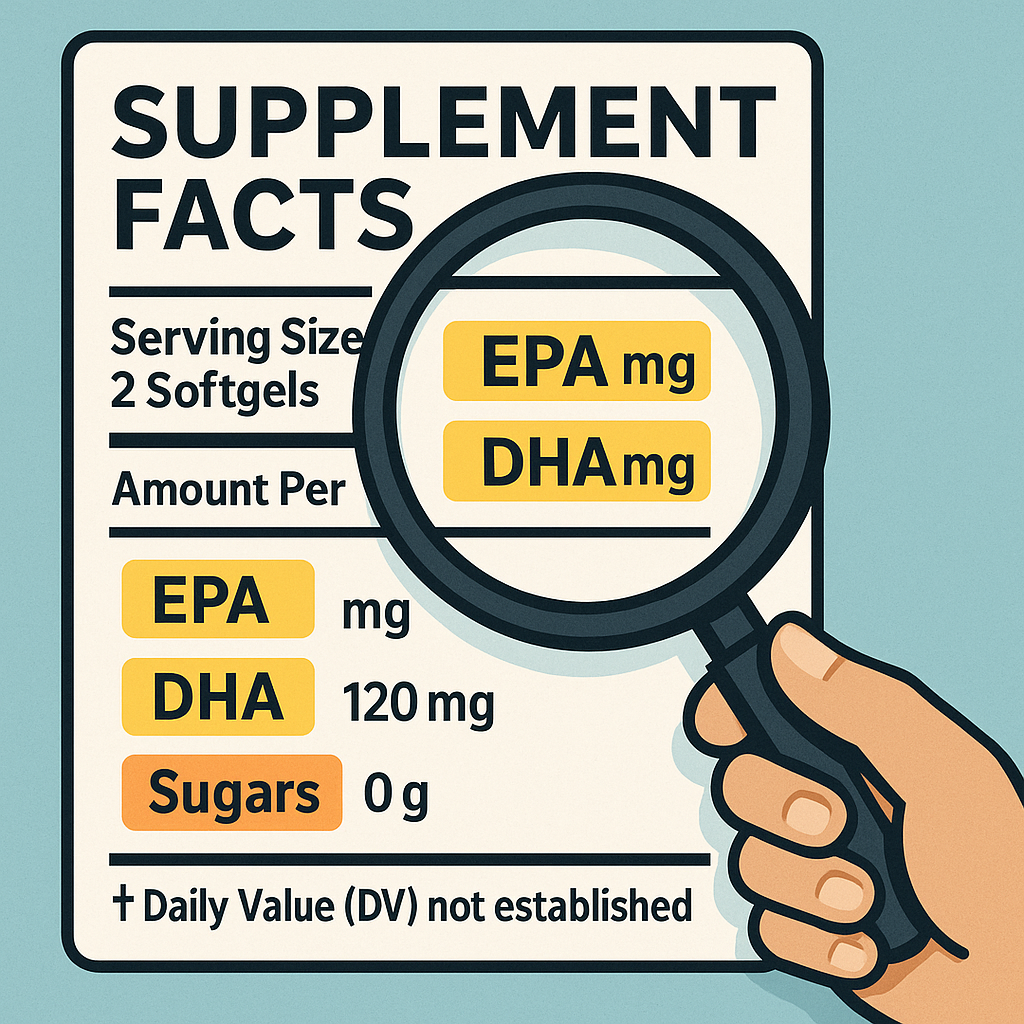
Step-by-step label checklist (scan in this order)
- Serving size: Is it 1 gummy, 2 gummies, or more?
- Find EPA (mg) and DHA (mg): ideally listed separately.
- Add them: EPA + DHA = total long-chain omega‑3 per serving.
- Check sugars (or sugar alcohols): multiply by how many gummies you’ll actually take per day.
- Check the source: fish oil vs. algal oil (a leading option among fish oil alternatives for vegetarians/vegans or fish-averse households).
- Quality signals: expiry date, storage guidance, and preferably third-party testing/quality statements (e.g., oxidation/rancidity controls).
Red flags that should make you pause
- “Fish oil ___ mg” with no EPA/DHA breakdown. This is a common way shoppers end up underdosed.
- Very low EPA+DHA paired with bold claims about learning, focus, or “brain booster” effects.
- High added sugar when the suggested serving requires multiple gummies per day.
- Cod liver oil gummies without clarity on vitamins A and D (which can be excessive in some situations).NCCIH
Simple rule: if a product makes it hard to calculate EPA+DHA, it’s hard to predict results—no matter how good it tastes.
Gummies vs. Other Fish Oil Alternatives (What to Choose If Capsules Don’t Work)
Gummies are just one capsule-free option. If softgels fail, there are other workable fish oil alternatives—some with better dose density and some with better sensory acceptance.
The right choice depends on taste/texture, dietary restrictions, and the EPA+DHA total you’re trying to reach.
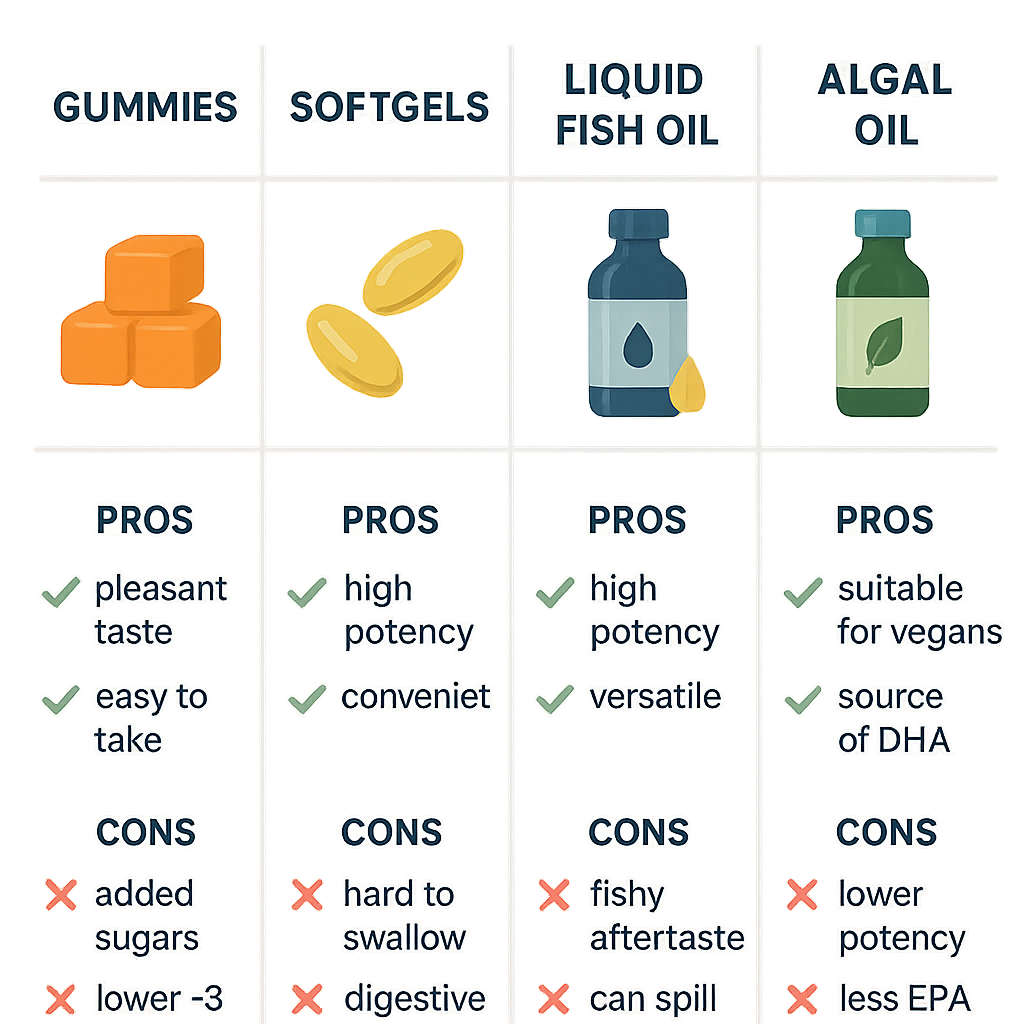
Options comparison
| Form | Pros | Cons | Best for |
|---|---|---|---|
| Fish oil gummies | Easy routine; palatable; strong adherence potential | Often lower EPA+DHA; added sugars; may require multiple gummies | Kids/teens and adults who refuse capsules |
| Liquid fish oil | Higher dose density; easier to scale EPA+DHA | Taste/texture barriers; storage matters; “fishy” risk if oxidized | Adults/families needing higher EPA+DHA |
| Mini-softgels | Lower swallowing barrier than large softgels; often more concentrated than gummies | Still a pill; not ideal for young children | Adults who dislike large capsules |
| Standard softgels | Widely available; often economical; decent dose density | Swallowing difficulty; fishy burps for some people | Adults who can tolerate pills |
| Algal oil (DHA-focused) | Vegetarian/vegan; direct DHA source; relevant fish oil alternative | Often more expensive; EPA may be lower unless included | Vegetarians/vegans; fish allergy households; DHA-first goals |
| ALA-only plant oils (flax/chia) | Helpful dietary fat; easy to add to meals | Limited ALA → EPA/DHA conversion; may not replicate EPA/DHA outcomesNIH ODS | Diet support, not a direct EPA/DHA replacement |
Seafood-first approach (a strong foundation)
Supplements can help, but seafood remains a foundational source of EPA and DHA. NCCIH notes that U.S. dietary guidance encourages seafood intake
(for adults, commonly summarized as about 8 ounces per week; children’s amounts vary by age).NCCIH
Many families do best with a hybrid plan: aim for seafood when possible, then use gummies as a reliable “gap filler.” This is also where
omega 3 gummies benefits can shine—supporting consistency when food intake isn’t predictable.
Omega‑3 Dosage: Practical Guidance for Kids and Adults (Without Overstepping Medical Advice)
There isn’t one universal omega‑3 dose that fits everyone, because studies vary by goal, EPA/DHA ratio, and duration. You can still make smart decisions by
focusing on measurable intake (EPA+DHA) and choosing a format you can stick with.
Why dosing feels confusing
- Different studies use different amounts and EPA:DHA ratios for different outcomes.
- Front labels often emphasize “fish oil mg,” which may not reflect EPA+DHA content.
- Kids aren’t small adults; age, diet, and health context matter.
A practical approach you can use
- Choose your goal category: general dietary support vs. a targeted goal that should involve clinician guidance.
- Calculate your daily EPA+DHA from the label (not “fish oil mg”).
- Check tradeoffs: dose density vs. sugar load if using gummies.
- Commit to consistency for weeks to months; most outcomes are not “overnight.”
If you’re considering higher intakes based on a study you saw online, bring the Supplement Facts panel to a pediatrician or dietitian and ask a specific question:
“Based on my child’s age, diet, and health context, what daily EPA+DHA amount (if any) makes sense?”
Dose-limiting factors that are more common with gummies
- Sugar and calories: if it takes many gummies to reach your intended EPA+DHA total, sugar may become a meaningful tradeoff—especially for kids.
- Dental considerations: sticky gummies can cling to teeth; consider taking with a meal and rinsing with water afterward.
- Overuse risk: because gummies taste like candy, adult-controlled storage is important.
- Cost: multiple daily servings can become expensive compared with concentrated softgels or liquids.
Safety, Quality, and “Parent-Proofing” Omega‑3 Gummies
Gummies can be family-friendly, but they also come with unique safety considerations. To get omega 3 gummies benefits without avoidable downsides,
focus on storage, age-appropriateness, and freshness.
Safety checklist for families
- Store like medicine: out of reach, ideally in child-resistant packaging. Gummies are a common overuse risk because they taste like candy.
- Follow age guidance and choking precautions: younger children may not be ready for gummies depending on chewing ability and supervision.
- Check allergens and ingredients: fish, gelatin, flavorings, and colorings may matter for sensitive individuals.
- Take with food if needed: some people experience mild GI upset from omega‑3s; taking with a meal can help.
Oxidation/rancidity: why freshness matters
Omega‑3 fats are prone to oxidation. Oxidized oils can smell/taste unpleasant and may indicate reduced freshness. Check the expiry date, follow storage directions
(cool, dry, and away from heat/light), and avoid products with strong off-odors. Brands that provide third-party testing or quality statements can reduce guesswork.
Medication interactions and special situations
If you’re aiming for higher-dose omega‑3 intake, discuss it with a clinician—especially if you take blood-thinning medications or have bleeding-related medical concerns.
NCCIH includes safety considerations and cautions for certain contexts.NCCIH
For pregnancy and breastfeeding, DHA needs are often discussed with a clinician; avoid self-prescribing high doses.
How to Get Kids (and Capsule-Hating Adults) to Take Omega‑3 Consistently
For most households, the “best” omega‑3 is the one that becomes a stable habit. Gummies can outperform capsules here by removing the swallowing struggle and reducing
daily negotiation—two major barriers to adherence.
Adherence strategies that work in real life
- Attach it to an existing habit: breakfast, after-school snack, or dinner. Consistency beats “perfect timing.”
- Use simple explanations: “These help support your brain and eyes,” as part of a broader healthy routine.
- Make the parent the gatekeeper: kids don’t self-serve gummies.
- Reduce friction: keep the bottle in a consistent, adult-controlled location near where the routine happens (but out of reach).
- Rinse with water afterward: helpful for dental hygiene with sticky gummies.
When to reassess your format
- If you keep missing days: gummies may be the best option because they improve consistency.
- If you need many gummies daily: consider a more concentrated omega‑3 format to reduce sugar and improve dose efficiency.
Product Spotlight: Omega‑3 Fish Oil Gummies (60ct) — Where It Fits
If your household consistently struggles with softgels, a gummy can be a practical middle ground—especially when the priority is building an easy, repeatable routine.
One option you can evaluate is
Omega‑3 Fish Oil Gummies (60ct).
Editorial note: Evaluate any product by its Supplement Facts panel (EPA, DHA, serving size, and sugars). Avoid choosing based on front-label “fish oil mg” alone.
Who this format may suit
- Kids or teens who refuse capsules, where routine consistency is the primary obstacle.
- Adults who dislike softgels or struggle with swallowing.
- Families seeking steady daily intake as part of a broader nutrition plan (including seafood when possible).
How to evaluate it using the 60-second label scan
Before buying (or right after it arrives), identify EPA (mg), DHA (mg), serving size, and sugars. Then calculate daily EPA+DHA based on how many gummies you’ll actually take.
This is the most reliable way to judge whether your expected omega 3 gummies benefits are realistic.
Set expectations clearly
The format doesn’t guarantee results. The most reliable outcomes come from two fundamentals: a meaningful EPA+DHA intake and consistent use.
FAQ
1) Are omega‑3 gummies enough to replace fish oil capsules?
They can be—if the gummies provide a meaningful daily total of EPA + DHA and you take them consistently. Many gummies are lower-dose, so replacing capsules may require multiple
gummies per day, which can raise sugar and cost.
2) What omega 3 gummies benefits are most realistic for kids?
The most evidence-aligned discussion centers on DHA’s role in normal brain and retina structure and function.Valenzuela Báez, 2017
Gummies may also help by improving routine consistency. For attention/behavior support, evidence is mixed—discuss concerns with your child’s clinician.
3) How do I know if a gummy has enough EPA and DHA?
Look for EPA (mg) and DHA (mg) listed on the Supplement Facts panel, then add them to get total EPA+DHA per serving. Don’t rely on “fish oil (mg)” alone; it can overstate how much
EPA/DHA you’re actually getting.NIH ODS
4) Are plant-based omega‑3 gummies a good fish oil alternative?
It depends on the source. ALA-only gummies (flax/chia) are not equivalent to EPA/DHA because conversion is limited in many people.NIH ODS
For a true alternative that still provides DHA (and sometimes EPA), look for algal oil products.NCCIH
5) Do omega‑3 gummies have too much sugar for kids?
Not necessarily—but do the math. Check grams of sugar per serving and multiply by the number of gummies needed to reach your intended EPA+DHA intake. If it takes many gummies to reach a meaningful
amount, sugar can become a real tradeoff. Consider rinsing with water after and keep gummies parent-controlled to avoid overuse.
6) Should kids take DHA or EPA—what matters more?
DHA is often emphasized in pediatric nutrition discussions because of its structural role in the brain and retina.Valenzuela Báez, 2017
Many supplements include both EPA and DHA. What matters most is age-appropriateness, the total EPA+DHA delivered, and a routine your family can maintain.
7) What’s the best time of day to take omega‑3 gummies?
Most people do well taking omega‑3s with a meal to reduce stomach upset. The best time is the time you’ll remember every day. Consistency is a major driver of real-world
omega 3 gummies benefits.
Conclusion: Are Gummies “Enough”?
Omega‑3 gummies aren’t automatically better or worse than capsules—they’re simply a different delivery format. Gummies can be “enough” when:
(1) they provide a meaningful daily EPA+DHA amount, (2) the sugar tradeoff fits your household, and (3) they improve consistency.
In many homes, that third point—adherence—is what finally makes omega‑3 intake happen.
Start seafood-first when you can, then use supplements to fill gaps.NCCIH
No matter what format you choose, focus on the numbers that matter (EPA + DHA), not just “fish oil mg.”
If you want a capsule-free option to evaluate, you can review
Omega‑3 Fish Oil Gummies (60ct)
and apply the label checklist above to confirm your daily EPA+DHA and sugars.
CTA: If you share a Supplement Facts panel (photo or text), we can help you calculate total EPA+DHA per day and estimate how many gummies fit your goal—useful when comparing products
and balancing dose targets with real-life routines.
Sources & Further Reading
-
NIH Office of Dietary Supplements (ODS): Omega‑3 Fatty Acids Fact Sheet (EPA/DHA vs ALA; limited conversion)
— https://ods.od.nih.gov/factsheets/Omega3FattyAcids-HealthProfessional/ -
National Center for Complementary and Integrative Health (NCCIH): Omega‑3 Supplements—What You Need To Know
— https://www.nccih.nih.gov/health/omega3-supplements-what-you-need-to-know -
Valenzuela Báez R. (2017). Importance of omega 3 in children’s nutrition. Rev Paul Pediatr.
— https://pmc.ncbi.nlm.nih.gov/articles/PMC5417803/ -
Ajmera R. (consumer summary; not a clinical guideline): Should Kids Take Omega‑3 Supplements?
— https://www.healthline.com/nutrition/omega-3-for-kids
