


Key Takeaways
- B vitamins help your body *use* energy from food (energy metabolism), but they don’t act like caffeine and won’t “switch on” instant alertness if you’re already sufficient.
- The biggest real-world “energy” wins tend to happen when you’re correcting something genuine—like low B12/folate-related anaemia, poor intake, or absorption issues (common with certain diets, age, and medications).
- A food-first approach works for many people in Singapore; supplements can be useful when your diet or absorption can’t reliably cover the basics—just avoid megadoses (especially B6 and niacin) unless a clinician guides it.
Introduction
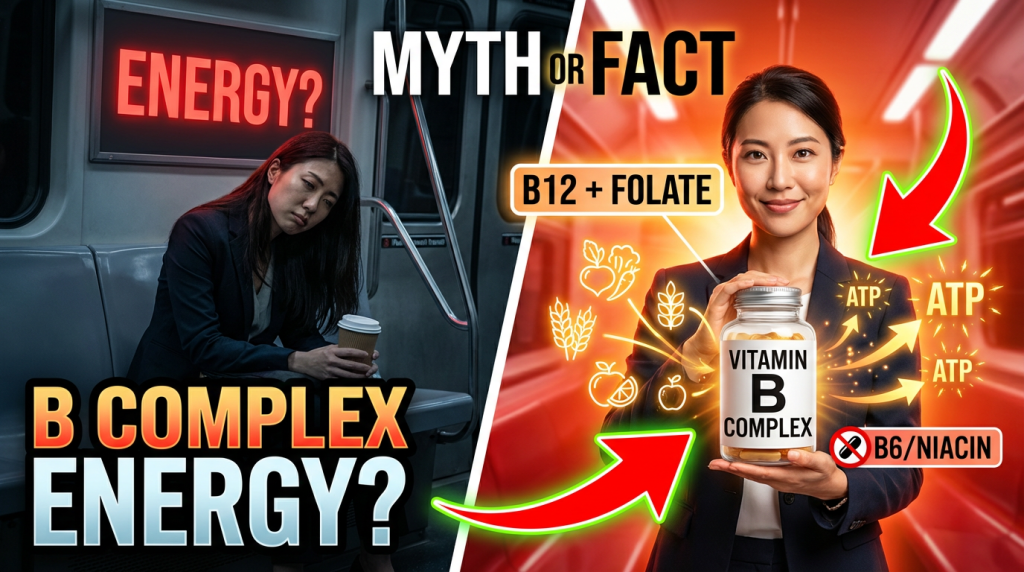
Picture this: it’s a weekday morning, you’ve slept “not enough but still okay,” you’re squeezing onto the MRT, and you’re already negotiating with yourself—*kopi now, or later?* Somewhere between the office and the next meeting, you see an ad that promises “more energy” with a Vitamin B Complex.
It’s a tempting idea, especially in Singapore’s busy work culture where being tired feels almost… normal. But here’s the thing: B vitamins are essential, and they absolutely matter for energy—just not in the way most marketing implies.
This article is about the evidence-based vitamin b complex benefits that actually hold up: how B vitamins support energy metabolism, what they can and can’t do for fatigue, who’s more likely to be low, and how to make practical, Singapore-friendly choices—food-first when possible, supplements when appropriate, and safety always.
Vitamin B complex benefits for “everyday energy” in Singapore: what it is (and what it isn’t)
You’ll hear the word “energy” used in at least three different ways, and mixing them up is where most confusion starts.
What counts as “energy” medically vs what you feel day-to-day
In the body, “energy” often means ATP—the cellular “currency” your cells use to do work. To make ATP, your body needs to process carbohydrates, fats, and proteins through a series of enzyme-driven steps.
In real life, what you feel as “energy” might be:
- Alertness (how awake you feel)
- Stamina (how long you can keep going)
- Motivation and mood
- The heaviness of sleep debt (which can feel exactly like low energy)
- Mental fatigue from stress and constant task-switching
Those aren’t the same thing. And importantly: B vitamins don’t override poor sleep, dehydration, or burnout.
Why B vitamins don’t work like caffeine: energy metabolism ≠ stimulation
B vitamins help enzymes do their jobs. They’re often described as coenzymes—basically, “helpers” that allow certain chemical reactions to happen efficiently. Many of those reactions sit inside energy-producing pathways.
But B vitamins don’t behave like stimulants. They don’t directly “rev up” your nervous system the way caffeine does. Caffeine changes how your brain perceives tiredness; B vitamins help the body run normal metabolic processes.
So if you take a B-complex tablet and expect a kopi-like lift in 20 minutes, you’re almost guaranteed to be disappointed.
Quick takeaway: when B-complex helps vs when it mostly doesn’t
A B-complex supplement tends to help most when:
- You’re not meeting needs through diet (restricted eating, poor appetite, chaotic meals)
- You have absorption issues (certain GI conditions or surgeries)
- You’re in a higher-risk group for specific deficiencies (more on this soon)
- A clinician has identified a deficiency (for example, B12/folate-related anaemia)
It tends to help least when:
- Your intake and absorption are already fine
- You’re using it as a “pick-me-up” while sleep and stress are doing the real damage
That doesn’t make B vitamins unimportant—it just puts them in their proper lane: supporting normal energy-yielding metabolism, not providing instant stimulation.
Inside the B-complex: the eight B vitamins, plus the two deficiency stories that matter (B12 + folate)
A “B-complex” usually refers to these eight vitamins:
- B1 (thiamin)
- B2 (riboflavin)
- B3 (niacin)
- B5 (pantothenic acid)
- B6 (pyridoxine and related forms)
- B7 (biotin)
- B9 (folate / folic acid in supplements)
- B12 (cobalamin)
Different products can include extra add-ons too. For example, the Nano Singapore Vitamin B Complex – 180ct includes the 8 B vitamins plus choline and PABA (para-aminobenzoic acid). That’s not “better” by default—it’s just a reminder that formulas vary, and you should always read the label rather than assume all B-complexes are interchangeable. (If you want to see what I mean by formulation differences, you can check the product page here: Nano Singapore Vitamin B Complex – 180ct.)
The coenzyme idea in plain English: “unlocking energy” from food
Think of energy metabolism like a kitchen line during peak lunch hour:
- The “ingredients” are carbs, fats, and protein
- The “staff” are enzymes
- The “tools” are coenzymes (many of which come from B vitamins)
Without the tools, the staff can’t work efficiently. But having *extra tools* doesn’t necessarily make the kitchen output more than it’s designed to produce—especially if you already have enough tools for the number of staff and orders.
That’s why correcting a deficiency can feel meaningful, while megadosing when you’re already sufficient often feels like… nothing.
The fatigue link that’s actually evidence-based: B12, folate, and (sometimes) B6
When people talk about B vitamins and tiredness, the most clinically relevant story is often blood health and oxygen delivery, not “metabolism speed.”
- Vitamin B12 and folate are both crucial for DNA synthesis and normal red blood cell production. When they’re low, you can develop megaloblastic anaemia, which commonly shows up as fatigue, weakness, and reduced exercise tolerance.
- Vitamin B6 supports amino acid metabolism and is involved in neurotransmitter synthesis; deficiency can also contribute to anaemia-like issues (though true deficiency is less common in typical diets).
If your tiredness is partly driven by anaemia, correcting what’s missing can be a genuine game-changer—because you’re fixing the underlying bottleneck.
Why formulas vary wildly (and why “100× daily value” isn’t automatically a flex)
Walk into any pharmacy aisle (or scroll an online marketplace) and you’ll notice something weird: some B-complex labels look “normal,” and others look like they belong in a bodybuilding forum.
There are a few reasons:
- B vitamins are water-soluble, so brands often imply “extra is harmless because you’ll just pee it out.” Sometimes that’s partly true—but it’s not the full story (especially for B6 and niacin).
- Some formulations are designed for specific clinical situations, but they’re sold broadly.
- “High potency” sells.
A useful reality check is to remember how small the daily requirements can be. For example:
- Vitamin B12 RDA for most adults is about 2.4 mcg/day
- Folate RDA for most adults is about 400 mcg DFE/day
- Vitamin B6 RDA for adults 19–50 is about 1.3 mg/day
When you compare those numbers to certain supplement labels, you’ll see why I’m not automatically impressed by “more.”
Food-first energy metabolism in Singapore: what to eat this week, and how to compare your options
If you’re in Singapore, food-first doesn’t have to mean expensive salads and protein shakes. You can cover a lot of B vitamins through normal, affordable meals—if you know what to look for.
Practical food sources of B vitamins (Singapore-friendly)
Here are realistic staples that show up in many local patterns:
B12 (standout nutrient for vegetarians/vegans)
- Naturally found in animal foods: fish, shellfish, meat, eggs, dairy
- Also found in fortified foods (depending on brand): certain breakfast cereals, nutritional yeast, some plant milks
Folate
- Leafy greens (think cai xin, spinach, kai lan)
- Legumes (lentils, chickpeas, beans)
- Some fruits (like oranges) and avocados
B1 (thiamin)
- Whole grains, legumes, pork
- Note: refining grains removes some naturally occurring B vitamins, which is why some rice and flour products are enriched.
B2 (riboflavin)
- Dairy, eggs, lean meats, green vegetables
B6
- Fish, poultry, potatoes, bananas, legumes
Niacin (B3)
- Meat, fish, peanuts, enriched grains
Biotin (B7) + pantothenic acid (B5)
- More widely distributed across foods; many mixed diets cover these without much effort
Hawker-centre and zi-char picks that nudge you in the right direction
You don’t need perfection—just better defaults you can repeat.
- Fish soup + add leafy greens: supports B12 intake, plus a generally lighter meal
- Economic rice: choose 1 protein (fish/egg) + 1–2 veg + tofu/beans when possible
- Yong tau foo: select tofu/beans + leafy veg; add egg if you eat it
- Nasi padang: choose grilled/steamed items and add vegetables (watch deep-fried options and heavy gravies if you’re doing this often)
- Zi-char: steamed tofu, sambal kangkong, stir-fried veg, egg-based dishes—then add a fish option when you can
If you’re vegetarian or vegan, the biggest “food-first” challenge is usually consistent B12. Folate is relatively easy with vegetables and legumes. B12 is the one that often needs a deliberate plan (fortified foods you actually eat regularly, or a reliable supplement).
A quick comparison: food-first vs B-complex vs targeted supplements vs “energy” products
There isn’t one perfect option—there’s the option that fits your diet, risk factors, and expectations.
| Option | What it can help | Best For | Notes |
|---|---|---|---|
| Food-first (balanced meals with whole grains, eggs/fish, legumes, leafy greens) | Covers a broad range of B vitamins and other nutrients that work together (protein, iron, magnesium, etc.) | Most healthy adults with a reasonably varied diet | Consistency matters more than “superfoods”; vegans need a dedicated B12 strategy (fortified foods or supplements). |
| B-complex near RDA-levels | Fills small gaps in intake; supports normal energy-yielding metabolism if diet is inconsistent | People with irregular meals, low appetite, or mild dietary gaps | Look for sensible doses close to daily needs; check for duplicates if you already take a multivitamin. |
| High-potency B-complex (often many times above daily values) | May correct inadequacy if intake is poor; sometimes used when clinicians want higher doses short-term | People with confirmed deficiency risk factors, under guidance | Watch B6 and niacin amounts; “high potency” isn’t automatically better and can increase side effects. |
| Targeted B12 or folate (single nutrient) | Addresses a specific deficiency (e.g., B12-related anaemia or low intake/absorption) | Vegans/strict vegetarians (B12), older adults, people with absorption issues, pregnancy planning (folate) | Targeted options are often clearer and safer than “kitchen sink” formulas; discuss testing if symptoms persist. |
| Caffeine/energy drinks | Improves alertness (short-term) | Occasional sleep debt moments, not a nutrient strategy | Not a substitute for nutrients; can worsen anxiety, sleep, and palpitations—especially if used late in the day. |
Use this table like a “decision shortcut”: if your problem is alertness, caffeine might change how you feel (with trade-offs). If your problem is a deficiency or dietary pattern, food-first or targeted supplementation makes more sense. And if you’re not sure what you’re dealing with—especially if fatigue is persistent—don’t guess.
How to choose between different supplement forms (capsules, tablets, gummies)
This is where practicality beats theory.
- Capsules/tablets: often more stable, less sugar, usually better value per dose.
- Gummies: easier to take, but often contain sugar and may have lower doses per serving; check how many gummies you need to reach the listed amounts.
- Sublingual B12: popular, but not necessarily “better” for everyone; absorption depends on the person and the dose. The bigger point is reliability and adherence—the best supplement is the one you’ll take correctly.
Buyer guidance: how to read a B-complex label without getting played
If you only remember one thing, make it this: don’t shop by hype words—shop by the numbers.
Here’s what to check:
1. Which B vitamins are included (and in what amounts)?
Some “B-complex” products are missing certain Bs, or barely include B12/folate.
2. Look for megadoses—especially B6 and niacin.
– Vitamin B6 has a tolerable upper limit (UL) of 100 mg/day for adults. Chronic high intakes are associated with peripheral neuropathy risk.
– Niacin has a UL of 35 mg/day for adults for supplemental/fortified sources; higher doses can cause flushing and more serious risks at pharmacologic levels.
3. Check for duplicates.
If you’re already on a multivitamin, pre-workout, or an “energy” blend, you might be stacking the same nutrients without realising it.
4. Quality signals matter more than buzzwords.
Look for clear manufacturer information, third-party testing where available, and transparent labelling. (For example, the Nano Singapore Vitamin B Complex product page states it’s formulated in Singapore and manufactured in a GMP-certified facility—details like this help when you’re trying to evaluate baseline quality.)
If you want a broader overview of what else you’re taking (and avoid doubling up), it can also help to browse by category rather than random search results—especially if you’re managing multiple supplements for different goals (general wellness, digestion, joints, and so on). Nano Singapore groups products into collections such as their General Health supplement collection, which makes it easier to compare what overlaps and what doesn’t.
Safety and red flags: avoiding megadoses (B6/niacin), and when to see a GP in Singapore
B vitamins are essential, but “essential” doesn’t mean “the more the better.” Two ingredients cause the most trouble in real-world supplement use: B6 and niacin.
Vitamin B6: the neuropathy risk people don’t expect
Vitamin B6 is involved in amino acid metabolism and neurotransmitter synthesis, and it’s easy to see why it gets marketed for “stress and mood.”
But high-dose, long-term B6 supplementation is associated with peripheral neuropathy risk (numbness, tingling, burning sensations, or altered sensation—often starting in hands/feet). The UL exists for a reason.
A practical tip: if you’re taking a B-complex daily, check the B6 number first. If it’s dramatically higher than what you need, ask yourself why you’re taking that dose.
Niacin: flushing is common—and high-dose use can be medically risky
Niacin (B3) is important in redox reactions (NAD/NADP), so it’s a real “metabolism” vitamin.
But niacin is also a classic example of how a nutrient can become a drug at high doses. Prescription-level niacin has been used to modify blood lipids, but it’s not something to self-prescribe. Over-the-counter high-dose niacin can cause:
- Flushing (warmth, redness, itching)
- GI upset
- And at very high intakes, more serious adverse effects (including liver concerns)
If a product is giving you obvious flushing, that’s not automatically “proof it’s working.” It may simply mean you’ve taken a form/dose that triggers a side effect.
Folate caution: the “masking” problem (don’t ignore B12 status)
Folate is critical for DNA synthesis and rapid cell division—especially relevant in early pregnancy.
But there’s a safety nuance people miss: high folic acid intake can mask B12 deficiency by improving anaemia-related blood markers while neurologic issues from low B12 continue.
If you’re in a higher-risk group for B12 deficiency (vegans/strict vegetarians, older adults, long-term metformin users, long-term acid-suppressing therapy, malabsorption conditions), it’s worth thinking about B12 status when taking folic acid—particularly in higher doses.
When fatigue is a red flag (please don’t self-treat forever)
I’m all for practical self-care, but persistent fatigue deserves a wider lens. Unexplained tiredness can signal many issues beyond vitamins, including:
- Iron deficiency or other anaemias
- Thyroid disease
- Depression/anxiety
- Sleep disorders (including obstructive sleep apnoea)
- Chronic infection/inflammation
- Medication side effects
- Poor sleep quantity/quality and stress load (the most common, and often underestimated)
Consider seeing a GP sooner (not later) if you notice:
- Fatigue lasting more than 2–4 weeks despite reasonable sleep and nutrition efforts
- Breathlessness, chest discomfort, or palpitations
- Unintentional weight loss
- Numbness/tingling, balance issues, or cognitive changes (possible B12-related neurologic symptoms among other causes)
- Very heavy menstrual bleeding or signs of anaemia
- Significant mood changes
A clinician may review your diet, medications (including metformin and acid suppressants), and decide whether targeted blood tests like B12 and folate are appropriate. That’s often more efficient than cycling through random supplements and hoping you guessed right.
Conclusion
Vitamin B complex can absolutely support the body’s normal energy processes—but it’s not a stimulant, and it can’t compensate for sleep debt, chronic stress, or an overall under-fuelled diet.
If you want the evidence-based approach, keep it simple:
1) start food-first with repeatable meals that cover B vitamin sources,
2) identify whether you’re in a higher-risk group for B12/folate issues, and
3) use supplements strategically (and safely) when diet or absorption isn’t enough.
If you’d like a convenient way to compare options and ingredients at your own pace, you can buy supplements online.
Frequently Asked Questions
Can I take a B-complex every day?
Many people can, but “can” and “should” aren’t the same. Daily use is most reasonable when your diet is inconsistent, you’re on a restricted diet, or you have a known risk factor. Check the label for high-dose B6 or niacin, and avoid stacking multiple products with overlapping B vitamins.
Why is my urine bright yellow after taking B vitamins?
That’s usually riboflavin (vitamin B2). It’s water-soluble, and excess amounts can be excreted in urine, which can look neon-yellow. It’s generally harmless, but it’s also a clue you may be taking more than you need.
Are stress and B vitamins connected?
B vitamins (especially B6, folate, and B12) are involved in normal nervous system function and neurotransmitter-related pathways. But if your stress is driven by workload, poor sleep, or anxiety, a B-complex won’t “cancel” that. Think of B vitamins as foundational nutrition—helpful if you’re low, but not a standalone stress treatment.
Do athletes need extra B vitamins for performance?
Usually only if intake is inadequate. B vitamins support energy metabolism, but taking extra when you’re already sufficient doesn’t reliably translate into better performance. Athletes often benefit more from overall calorie adequacy, protein, iron status (when relevant), hydration, and sleep.
Which test should I ask for if I suspect B12 issues?
Talk to a clinician rather than self-ordering blindly. Depending on your symptoms and history, they may consider serum B12 and related markers. This is especially important if you have neurologic symptoms (numbness/tingling, balance issues) or are in a higher-risk group (vegan diet, older age, long-term metformin, long-term acid-suppressing medications, malabsorption conditions).
References
- https://ods.od.nih.gov/factsheets/VitaminB12-HealthProfessional/
- https://ods.od.nih.gov/factsheets/Folate-HealthProfessional/
- https://ods.od.nih.gov/factsheets/VitaminB6-HealthProfessional/
- https://ods.od.nih.gov/factsheets/Niacin-HealthProfessional/
- https://ods.od.nih.gov/factsheets/Thiamin-HealthProfessional/
- https://ods.od.nih.gov/factsheets/Riboflavin-HealthProfessional/
- https://nutritionsource.hsph.harvard.edu/vitamins/
- https://www.mayoclinic.org/drugs-supplements-vitamin-b12/art-20363663
Disclaimer
All the content on this blog, including medical opinion and any other health-related information, is solely to provide information only. Any information/statements on this blog are not intended to diagnose, treat, cure or prevent any disease, and should NOT be a substitute for health and medical advice that can be provided by your own physician/medical doctor.
We at Nano Singapore Shop encourage you to consult a doctor before making any health or diet changes, especially any changes related to a specific diagnosis or condition.
